


Keratin repair treatments smooth the cuticle and add temporary strength to damaged, frizzy hair, but they don’t biologically regrow lost hair tissue. The hair shaft is nonliving, so no treatment reverses structural damage at the cellular level. What you get instead is real: less frizz, more shine, and easier styling within days. For genuine bond repair on chemically damaged or bleached hair, you need bond-building chemistry or a professional corrective service, not a coating.
TL;DR:
- Keratin treatments temporarily smooth hair and reduce frizz by coating the outer cuticle, but do not repair internal structural damage or broken bonds inside the cortex.
- Professionally applied keratin treatments last longer and are more concentrated, making them more effective for significant damage compared to at-home products, which offer milder, short-term results.
- For lasting improvement on chemically damaged hair, bond-building treatments or covalent grafting approaches, like QAI Hair’s PolyGraft-9, target internal structures rather than surface coatings.
- Scalp irritation, excessive protein buildup, and old formaldehyde-releasing formulas pose risks; a patch test and choosing formaldehyde-free options are advisable before treatment.
- Proper aftercare, including waiting 48 to 72 hours before washing, using sulfate-free shampoo, limiting heat styling, and trimming regularly, can extend the lifespan of a keratin treatment.
What Is a Keratin Repair Treatment, and How Does It Work?
Keratin is the structural protein that makes up roughly 90% of your hair. Salon keratin smoothing services and at-home keratin products both work by depositing a protein layer onto the hair shaft, but they operate at different depths and with different staying power.
The distinction that matters most is cuticle versus cortex. The cuticle is the outer, shingle-like layer that determines how light reflects (shine) and how much moisture escapes (frizz). Most keratin products coat and temporarily seal this layer. The cortex is the inner structural core, where disulfide bonds hold the hair’s shape and strength. Sealing the cuticle does nothing to repair broken bonds inside the cortex.
Because the hair shaft is nonliving tissue, no product regenerates its original internal architecture. Treatments improve appearance and temporarily restore function. Real bond repair requires different chemistry, and understanding that difference decides which product actually solves your problem.
What Can (and Can’t) a Keratin Treatment Realistically Fix?
Keratin treatments reliably reduce frizz, cut down styling time, and add temporary smoothness and shine. Most people notice the cosmetic change immediately, often within the first wash after application.
What they don’t do is regenerate the internal structure of already-damaged hair or permanently fuse split ends back together. A split end stays split; keratin coating can only smooth its surface until the section grows out or gets trimmed.
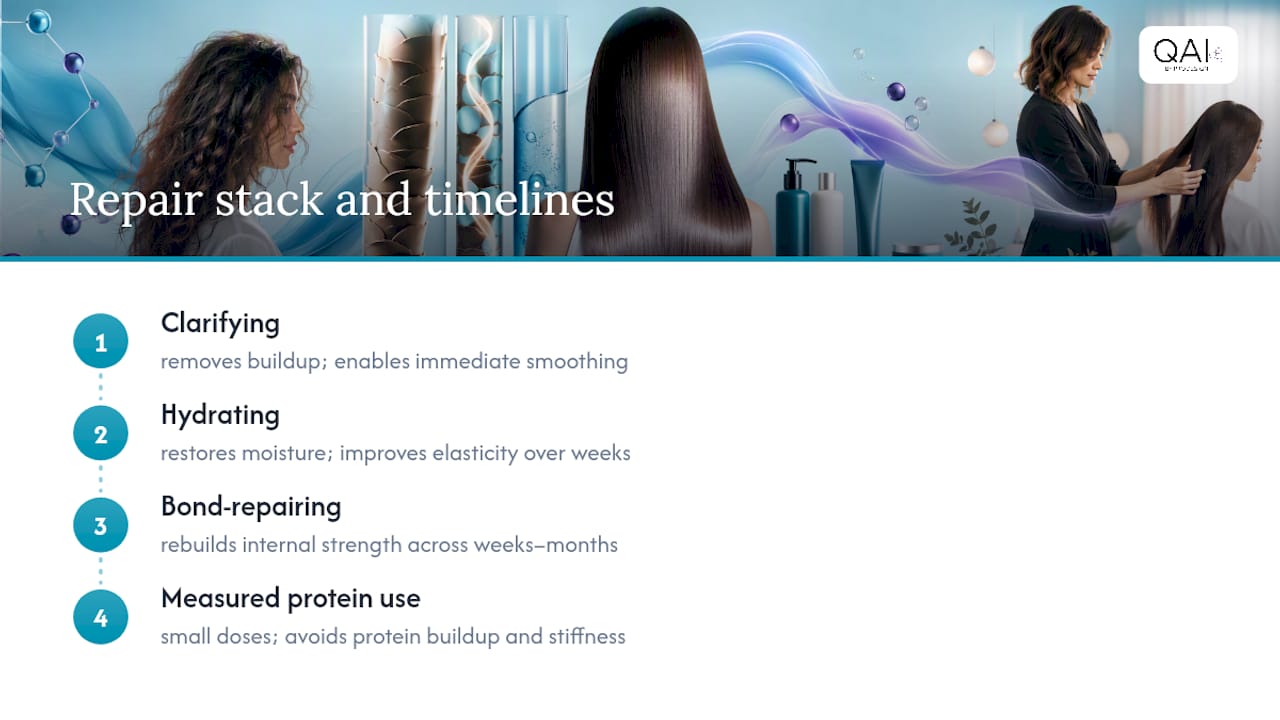
Expect two different timelines running at once. The cosmetic shift, smoother texture and shine, shows up right away. The deeper improvement in how hair actually feels and behaves, less breakage, better elasticity, takes weeks to months of consistent care, following something like the repair-stack sequence of clarifying, hydrating, bond-repairing, and measured protein use. Skip that sequence and pile on protein too fast, and you risk the opposite effect: stiff, brittle strands from protein buildup on top of already-compromised hair.
Is Your Hair a Good Candidate for Keratin Smoothing?
Not every damage profile responds the same way to keratin, so a quick self-check saves you money and disappointment.
Signs that keratin smoothing will likely help:
- Persistent frizz and a rough, lifted cuticle you can feel when you run fingers down a strand
- Uneven porosity that causes color to fade unevenly or absorb product too fast
- Dryness and dullness without significant breakage
Red flags that point to something keratin can’t fix:
- Hair that stretches significantly and doesn’t spring back (a sign of bond damage, not just surface wear)
- Scalp irritation, flaking, or unusual shedding, which needs a trichologist rather than a smoothing product
- Heavy breakage concentrated at one length, often from a bleach or chemical service gone wrong
A simple elasticity test (wet a strand, stretch it gently, watch if it snaps back) and a porosity check (does a strand float or sink in a glass of water) tell you more in five minutes than any product label will. If ends are severely split, trim first. Keratin will not save them.
Salon Keratin Services vs. At-Home Keratin Products
Professional application and at-home routines solve overlapping problems, but they’re not interchangeable, and the gap comes down to concentration, technique, and how long results hold.
Salon treatments use higher-concentration formulas applied under heat and controlled timing, which is why results look dramatic and can last for a noticeably longer period of reduced frizz. A trained stylist can also adjust the formula for your hair’s specific porosity and damage level in real time, something no bottle instructions account for.
At-home keratin products, including leave-ins and lower-concentration treatments, generally deliver milder, more gradual smoothing with shorter-lived results, closer to two to four weeks. They work best as maintenance between salon visits or for mild frizz rather than significant damage.
The trade-offs break down like this:
- Cost: Salon services cost more upfront but last longer per application; at-home products cost less per use but need frequent repurchasing.
- Time: Salon treatments take one to three hours in a chair; at-home products fit into a normal wash routine.
- Safety: Professional settings allow better ventilation and formula control, which matters if a salon still uses formaldehyde-releasing formulas. Ask directly about the formula before booking.
How to Make a Keratin Treatment Last Longer
What you do in the weeks after a treatment determines whether you get four weeks of results or twelve.
- Wait before washing. Most keratin services need 48 to 72 hours before the first wash, since early washing can undo the smoothing.
- Switch to sulfate-free shampoo. Sulfates strip the protein layer faster; a gentler formula preserves it longer between washes.
- Rotate hydrating masks with bond builders. Alternate a moisture-focused mask one week with a bond-repair treatment the next, especially if your hair is also color-treated or previously bleached.
- Limit heat styling to two or three times a week, and always use a heat protectant. Constant flat-ironing cancels out the smoothing you just paid for.
- Trim every eight to ten weeks. This keeps split ends from creeping upward and undermining the smooth look you’re maintaining.
Pro Tip: If your hair is fine or low porosity, skip heavy oils right after treatment. A light leave-in does more for shine without weighing the strands down or making them look flat.
What Are the Risks and Side Effects of Keratin Treatments?
The two most common complaints are protein overload and scalp irritation. Protein overload happens when you stack too many protein treatments without enough moisture in between, leaving hair stiff, dry, and prone to snapping instead of stretching.
Ingredient risk is the other concern, particularly with older salon formulas that release formaldehyde gas when heated. Formaldehyde-free alternatives now dominate the professional market and avoid that exposure entirely, but it’s worth asking your stylist directly which formulation they use before you sit down.
A patch test 48 hours before any new chemical service catches allergic reactions early. If you notice ongoing scalp irritation, flaking, or unusual sensitivity, pause protein treatments and consider a trichologist evaluation rather than pushing through with more product. Chronic heat damage compounds quickly, and conservative use of both heat and chemical services prevents the kind of damage no keratin coating can undo.
The Science Behind QAI Hair’s Covalent Grafting Approach
Most keratin products sit on top of the hair shaft. QAI Hair’s PolyGraft-9 Complex works differently: it’s built as a reactive covalent grafting polypeptide, engineered to bond into the hair’s internal structure rather than coat over it. Founder Dr. Lee Hunter developed the system after 37 years in personal care research, including leadership roles at Clairol and Redken, and the technology’s original documentation describes it as targeting all three layers of the hair shaft rather than just the outer cuticle.
That distinction matters for anyone comparing surface smoothing to genuine structural work. Where this fits into a repair stack:
- QAI Tiger Reconstructor Masque slots in as the intensive, bond-focused step for hair with visible breakage or chemical damage.
- QAI Tiger Reconstructing Shampoo functions as ongoing maintenance, supporting the masque’s work between deeper treatments.
- For bleach damage, porosity imbalance, or color fade beyond what home products address, QAI Hair’s professional corrective services are the next step up.
A Realistic Plan, Not a Miracle Fix
If your hair is genuinely damaged, don’t start with keratin. Trim split ends first, then run a bond-building routine for several weeks before layering in smoothing treatments. Keratin coating looks great on healthy structure; it does very little on top of broken bonds. Watch how your hair responds week to week rather than expecting one product to solve everything at once, and if progress stalls, a licensed stylist or a professional evaluation will tell you more in one visit than another month of guessing.
— Kollin Gessler
Which QAI Hair Product Fits Your Repair Routine?
QAI Hair gives you a structural alternative to surface-level keratin coating: PolyGraft-9 targets the cortex directly instead of just smoothing the outside, so you’re not just masking damage between trims. 
If your hair shows breakage, bleach damage, or uneven porosity, start with the QAI Tiger Reconstructor Masque as your intensive repair step, then follow with the QAI Tiger Reconstructing Shampoo to hold results between treatments. If your damage is milder, frizz and dullness without real breakage, at-home products alone may be enough for now. For bleach correction, significant color fade, or chemical damage beyond what a masque can address, QAI Hair’s permanent keratin repair and chemical corrective services bring professional-grade PolyGraft-9 application to the problem directly. Browse the full Tiger Controlled Effects lineup to see how each product maps to a specific damage stage, and start with whichever step matches where your hair actually is right now.
Sources
For more on why hair can’t fully regenerate once damaged, Medical News Today’s overview breaks down the biology in plain terms. For a practical sequencing guide to bond builders and protein use, the repair-stack guide from CareAboutYourHair walks through the order that actually works. QAI Hair’s own technical explainer on covalent grafting covers the mechanism behind PolyGraft-9 in more depth, and the 4-step cuticle-sealing routine offers a simpler starting point for less severe damage.
- How to repair damaged hair: Methods and how they work — Medical News Today
- How to repair damaged hair: 9-Step Repair Stack Guide — CareAboutYourHair
FAQ
Does a Keratin Treatment Repair Hair?
Keratin treatments smooth the cuticle and improve appearance, shine, and manageability, but they don’t biologically repair the hair’s internal structure. For genuine bond repair, chemically damaged hair needs bond-building treatments or a covalent grafting approach that works within the cortex.
What Is the Downside of Keratin Treatment?
The main downsides are protein overload from overuse, which leaves hair stiff and brittle, and formula risk from older formaldehyde-releasing products. Sticking to formaldehyde-free formulas and spacing out protein treatments avoids both issues.
Can a Keratin Treatment Repair Damaged Hair?
It improves the look and feel of damaged hair by sealing the cuticle, but it can’t reverse broken internal bonds. QAI Hair’s PolyGraft-9 technology is built specifically to target that deeper structural layer rather than just coat the surface.
What Is the Best Keratin Treatment for Damaged Hair?
The best option depends on how severe the damage is. Mild frizz responds well to at-home keratin products, while chemically damaged or bleached hair typically needs a bond-focused masque, like the QAI Tiger Reconstructor Masque, or a professional corrective service.

