


Keratin treatment side effects range from acute irritation during the appointment to longer-term hair structural damage and, in some formulations, meaningful formaldehyde exposure. The most common short-term reactions are eye and throat irritation, coughing, headaches, nausea, and skin redness. The bigger concern for repeated exposure is formaldehyde, a chemical classified as a human carcinogen that some smoothing products release when heated. If you’re experiencing symptoms right now:
- Leave the salon or treatment area and get fresh air immediately.
- Remove any clothing that absorbed product fumes.
- Flush eyes or skin with clean water for at least 15 minutes if there was direct contact.
- Seek medical care for any breathing difficulty, chest tightness, or symptoms that don’t clear up within an hour.
- Write down the salon name, stylist, and product used before you leave.
OSHA has issued formal hazard alerts about formaldehyde in salon settings. The FDA has warned that products labeled “formaldehyde-free” can still release the chemical when a flat iron is applied. The National Cancer Institute classifies formaldehyde as a known human carcinogen. For readers who want smoothing results without that chemical risk, QAI Hair’s formaldehyde-free professional systems are one option worth considering.
Pro Tip: Screenshot the product name and ingredient list at the salon before your appointment starts. If symptoms develop later, that documentation is what a doctor or OSHA investigator will need first.
Key Takeaways
Formaldehyde exposure from heated keratin treatments is the central health risk, and it affects both clients and salon workers regardless of whether a product is labeled “formaldehyde-free.”
| Point | Details |
|---|---|
| Acute side effects are common | Eye, throat, and nasal irritation, headaches, nausea, and skin reactions can begin during the flat-iron phase. |
| “Formaldehyde-free” labels can mislead | Methylene glycol and other releasers convert to formaldehyde gas under heat; always request the Safety Data Sheet. |
| High-risk groups should avoid | Pregnant people, those with asthma, children, and frequent salon workers face disproportionate inhalation and contact risk. |
| Hair damage accumulates | Repeated chemical and heat cycles raise porosity, cause breakage, and can permanently alter curl pattern. |
| QAI Hair offers a lower-risk path | QAI Hair’s formaldehyde-free professional systems deliver frizz control and structural repair without heat-activated chemical release. |
What a keratin treatment actually does to your hair
A keratin smoothing treatment is a salon service that applies hydrolyzed keratin protein, a chemical bonding agent, and heat to temporarily relax the hair’s natural curl pattern and smooth the cuticle. The result lasts roughly 6 weeks to 5 months depending on the formula, your hair type, and how you maintain it.
The chemistry matters for safety. Many formulas use formaldehyde or formaldehyde-releasing compounds such as methylene glycol as the bonding agent. When a stylist passes a flat iron over the treated hair at temperatures that can exceed 450°F, those compounds release formaldehyde gas into the salon air. As Dermatology Times explains, the heat-activation step is precisely what converts liquid methylene glycol into airborne formaldehyde.
A typical appointment runs 2–4 hours. Results generally hold for 2–5 months with proper aftercare, though fine or already-processed hair often sees fading sooner. The cost varies widely by salon and region, but the chemical exposure window is the same regardless of price point.
Keratin treatment side effects you may notice right away
Most acute reactions begin during the flat-iron phase, when formaldehyde concentrations in salon air peak. Stylists who perform multiple treatments in a day tend to report symptoms more often than clients who sit through a single session, but clients are not immune.
Common short-term symptoms:
- Eye irritation and tearing — often the first sign; formaldehyde is a potent mucous-membrane irritant even at low concentrations.
- Nasal and throat irritation — burning, dryness, or a scratchy sensation that begins during heating.
- Coughing and wheezing — particularly in people with any underlying airway sensitivity.
- Headache and dizziness — reported during and within hours after treatment.
- Nausea — less common but documented, especially in poorly ventilated spaces.
- Skin redness or rash — contact dermatitis from the product itself, distinct from inhalation effects.
- Chest discomfort — a red flag that warrants leaving the area immediately.
The Cleveland Clinic notes that eye, nose, and throat irritation, coughing, wheezing, skin reactions, headaches, dizziness, and nausea are all reported reactions to keratin treatments containing formaldehyde.
Allergic contact reactions and inhalation effects are different mechanisms. Inhalation symptoms start fast, often within minutes of flat-ironing. Contact dermatitis may take 24–72 hours to appear on the scalp or neck.
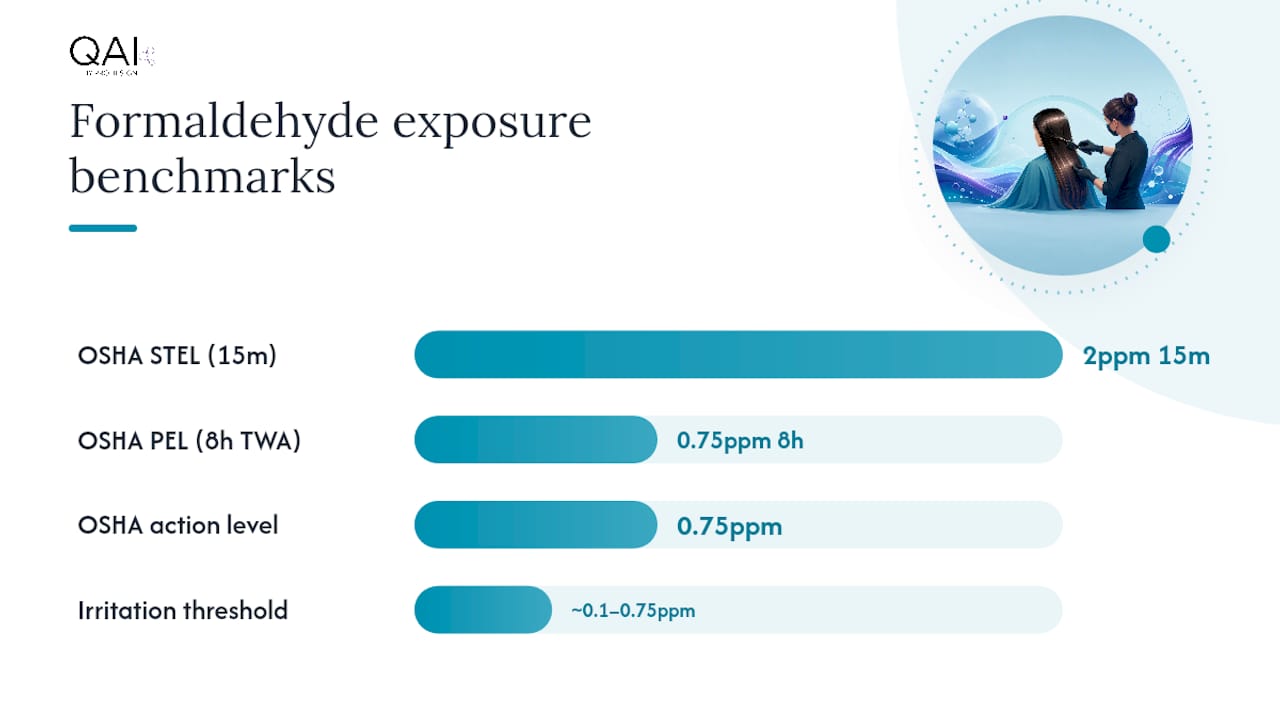
Measured salon air concentrations matter. Studies have recorded formaldehyde levels in salon air during blow-drying and flat-ironing that exceed irritation thresholds in some measurements. OSHA’s permissible exposure limit (PEL) is 0.75 ppm as an 8-hour time-weighted average, with a short-term exposure limit (STEL) of 2 ppm. Some salon measurements during active treatment have exceeded those thresholds, which explains why acute symptoms appear even in clients who are only present for one appointment.
Long-term risks and what U.S. agencies say about occupational exposure
Single-appointment exposure is one thing. Stylists who perform keratin treatments daily face a fundamentally different risk profile, and that’s where agency guidance gets serious.
The National Cancer Institute classifies formaldehyde as a known human carcinogen based on epidemiologic evidence and animal studies. Occupational exposure in high-concentration settings has been associated with nasopharyngeal cancer and leukemia in research populations.
An NIH-reported observational study found an association between frequent use of hair-straightening chemicals and higher uterine cancer risk. The NIH was careful to frame this as an association from observational data, not proof of causation, and called for further research. Still, the signal is worth taking seriously, particularly for people who use these products repeatedly over years.
OSHA’s formaldehyde factsheet describes chronic health effects from repeated inhalation exposure and requires employers to implement engineering controls, provide PPE, and monitor air quality when formaldehyde is present in the workplace.
| Exposure benchmark | Level | Source |
|---|---|---|
| OSHA permissible exposure limit (PEL) | 0.75 ppm (8-hr TWA) | OSHA |
| OSHA short-term exposure limit (STEL) | 2 ppm (15-min) | OSHA |
| OSHA action level | 0.75 ppm | OSHA |
| Irritation threshold (mucous membranes) | ~0.1–0.75 ppm | Published study ranges |
Pro Tip: *Salon owners should conduct air monitoring during actual treatment procedures, not just in empty rooms. Formaldehyde concentrations spike during the flat-iron phase and can drop quickly afterward, so a general air reading underestimates peak worker exposure. OSHA’s free On-Site Consultation Program can help small salons set up proper monitoring.
How keratin treatments can damage your hair over time
The cosmetic pitch for keratin treatments is that they repair hair. The reality is more complicated. The chemical and heat process that creates smoothness also stresses the hair’s internal structure, and repeated cycles compound that stress.
Medical News Today reports that keratin treatments can cause dryness, breakage, and loss of natural curl patterns alongside their smoothing effects, and that the structural impact accumulates with repeated use.
Hair-specific outcomes to watch for:
- Temporary smoothness followed by increased brittleness — the cortex can thin with repeated chemical exposure.
- Split ends and mid-shaft breakage — especially where heat is applied most intensely.
- Elevated porosity — the cuticle, once repeatedly opened and reset, may not close as tightly, leaving hair more vulnerable to moisture loss.
- Loss of curl definition — some clients find their natural texture doesn’t fully return between treatments.
- Scalp irritation or hair shedding — less common, but reported in cases of product contact with the scalp.
Hair that’s already been bleached, colored with permanent dye, or chemically relaxed is the most vulnerable. The cuticle is already compromised in those cases, and adding another chemical process accelerates damage. Spacing treatments at least 3–4 months apart reduces cumulative harm, but it doesn’t eliminate it.
Pro Tip: If your hair snaps when you gently stretch a wet strand rather than stretching slightly and returning, that’s a sign of severe elasticity loss. Stop further chemical processing and look into reconstructive treatments. QAI Hair’s Tiger Reconstructor Masque is designed specifically to address cortex-level damage from repeated chemical and heat exposure.
Who should avoid keratin treatments entirely
Some people face disproportionate risk from keratin smoothing treatments, and for them the cosmetic benefit rarely justifies the exposure.
- Pregnant and breastfeeding people — formaldehyde crosses biological barriers, and precautionary guidance from dermatology and occupational-health experts recommends avoiding exposure entirely during pregnancy. Evidence on fetal risk is incomplete, which is exactly why caution applies.
- People with asthma or chronic respiratory disease — even low formaldehyde concentrations can trigger bronchospasm. A single treatment can provoke a serious asthma attack.
- Children — their airways are smaller, their detoxification capacity is lower, and there’s no cosmetic justification that outweighs the inhalation risk.
- People with chemical sensitivities or existing contact dermatitis — the scalp and skin barrier are already reactive; adding a formaldehyde-releasing product raises the likelihood of a severe contact reaction.
- Salon workers with frequent exposure — cumulative occupational exposure is the highest-risk scenario in this entire discussion. Stylists performing multiple treatments per week face a meaningfully different risk profile than a client who visits once a year.
If you fall into any of these groups and still want smoother hair, the safer alternatives section below is where to focus.
How to lower your risk before, during, and after a treatment
Before your appointment
- Ask the salon for the full ingredient list of the product they use, not just the brand name.
- Look for formaldehyde synonyms on the label: methylene glycol, formalin, methanal, methylene oxide, oxymethylene, and timonacic acid are all formaldehyde sources.
- Ask whether the salon has local exhaust ventilation (not just ceiling fans or open windows).
- Request a patch test at least 48 hours before the full treatment.
- Ask what flat-iron temperature they use. Higher temperatures release more formaldehyde.
During the treatment
- Sit near any ventilation source. If the room feels stuffy or your eyes start watering, say something.
- Stylists should wear N95 respirators during the flat-iron phase, not just surgical masks.
Reading labels honestly
The FDA has confirmed that products marketed as formaldehyde-free can still release formaldehyde when heated, because methylene glycol converts to formaldehyde gas under heat. A “formaldehyde-free” label on the bottle is not a safety guarantee.
Safer smoothing alternatives
Carbocysteine-based systems are the most established lower-inhalation-risk alternative. They don’t rely on formaldehyde or formaldehyde-releasers, so the heated-gas risk is substantially lower. The trade-off, as Dermatology Times notes, is that carbocysteine systems typically deliver less dramatic smoothing and shorter-lasting results than formaldehyde-based formulas.
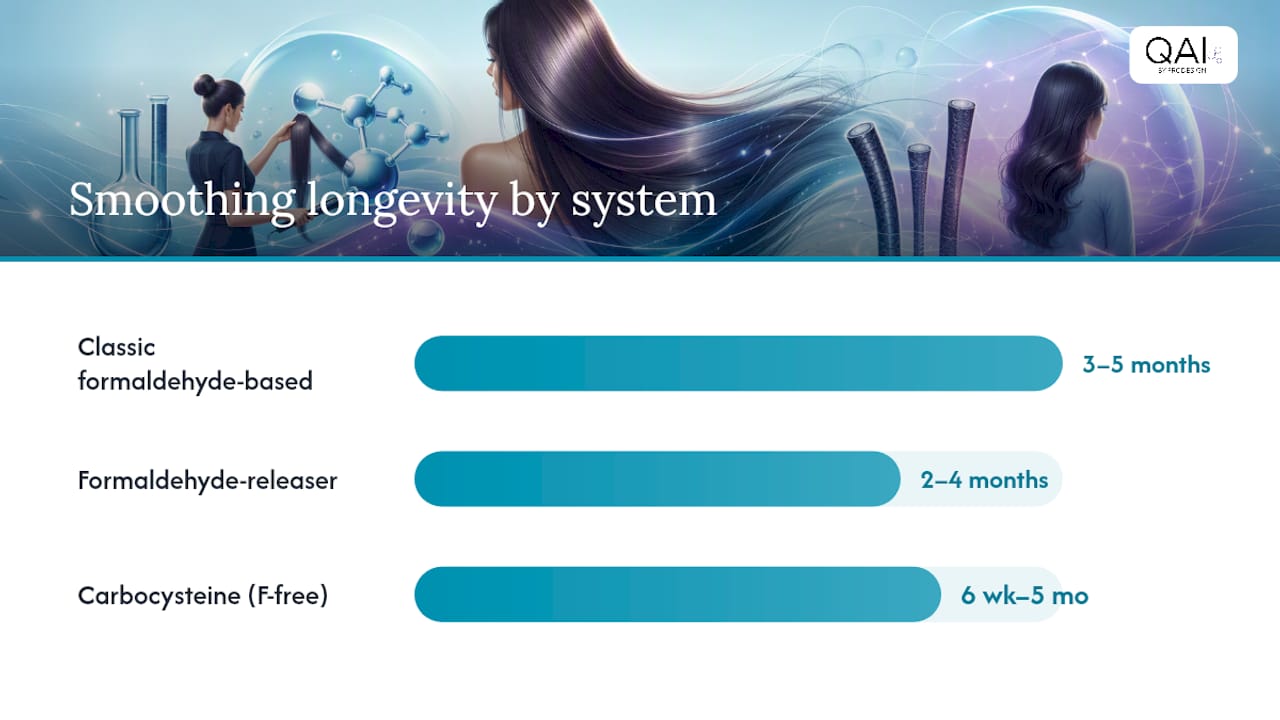
| System type | Health risk | Smoothing longevity | Typical results |
|---|---|---|---|
| Classic formaldehyde-based | High (inhalation, carcinogen risk) | 3–5 months | Strong frizz reduction, curl relaxation |
| Formaldehyde-releaser products | Moderate to high (heat-activated release) | 2–4 months | Moderate to strong smoothing |
| Carbocysteine / formaldehyde-free | Lower inhalation risk | 6 weeks to 5 months | Mild to moderate frizz reduction |
A legitimate SDS will list all hazardous ingredients. If they can’t produce one, that’s a red flag. Professional formaldehyde-free systems like those from QAI Hair come with full technical documentation precisely because transparency is part of the safety case.*
If you’re weighing options after a damaging treatment, extensions for chemically weakened hair can be a practical bridge while your hair recovers structural integrity.
What to expect after a keratin treatment: the real timeline
The first 48–72 hours
This window is non-negotiable. Don’t wash your hair, pin it, tuck it behind your ears, or let it get wet. The bonds are still setting. Any crease or bend that forms during this period can become permanent in the treatment. The Cleveland Clinic’s patient guide confirms that avoiding water and manipulation for 48–72 hours is the standard clinical recommendation.
Weeks 1–6
The smoothing effect is at its peak. Use only sulfate-free shampoo and conditioner. Sodium lauryl sulfate and sodium laureth sulfate strip the treatment faster and can also irritate a scalp that’s still recovering from chemical exposure. Avoid chlorinated pools and saltwater.
Aftercare essentials:
- Sulfate-free, sodium chloride-free shampoo only.
- Deep condition weekly to offset the drying effect of the chemical process.
- Limit heat styling where possible; when you do use heat, apply a thermal protectant.
- Avoid elastic hair ties that crease the hair shaft.
Months 1–3 and beyond
Most clients notice the smoothing effect beginning to soften around the 6-week mark, with significant fading by months 3–5 for most formulas. Fine hair and hair with high porosity typically sees results fade faster. By month 3, natural curl or wave usually starts returning at the roots as new growth comes in untreated.
Timeline snapshot: Smoothing results typically last 6 weeks to 5 months, with most clients seeing meaningful fading by the 3-month mark. Hair that was already porous or chemically processed before treatment tends to fall toward the shorter end of that range.
If structural damage appears during this period — snapping, excessive shedding, or a gummy texture when wet — don’t book a repeat treatment. Seek a professional assessment first.
What to do if you have symptoms after a treatment
- Stop exposure. Leave the salon or treatment area. Get outside or into fresh air as quickly as possible.
- Remove contaminated clothing. If product or fumes saturated your clothes, change as soon as you can to limit continued skin and inhalation exposure.
- Flush eyes or skin. If the product made direct contact, flush with clean running water for at least 15 minutes.
- Seek medical care for any breathing difficulty, persistent chest tightness, severe eye pain, or symptoms that don’t resolve within an hour of fresh air.
- Document everything. Write down or photograph: the salon name and address, the stylist’s name, the product name and any visible label information, and the date and time of treatment.
- Report the incident. Consumers can file an adverse event report with the FDA through MedWatch. Salon workers experiencing occupational exposure can file a complaint with OSHA or request a workplace inspection.
For stylists specifically:
- Document every treatment you perform where symptoms occur, including the date, product, and your symptoms.
- Request that your employer conduct air monitoring during actual treatment procedures.
- Ask about respiratory protection — N95 respirators, not cloth or surgical masks, are the appropriate standard for formaldehyde exposure.
Pro Tip: If you’re a salon worker and your employer dismisses your concerns, OSHA’s whistleblower protection program covers you. You can file a confidential complaint without your employer knowing who reported.
The case for health-first decision-making in the salon chair
The cosmetic appeal of keratin smoothing is real. Frizz control, reduced styling time, and smoother texture are genuine benefits that millions of people value. But the health case for caution is equally real, and it’s grounded in agency-level guidance from OSHA, the FDA, and the NCI, not just precautionary instinct.
What bothers me most about how these treatments are marketed is the gap between the “repair” framing and what the chemistry actually does. Calling a formaldehyde-based process a “hair repair treatment” is technically defensible in a narrow cosmetic sense, but it obscures the structural stress the process imposes. Clients deserve to know that the smoothing effect and the damage risk come from the same mechanism.
The practical answer isn’t to avoid all smoothing treatments. It’s to ask better questions, read ingredient lists with some skepticism, and choose formulas that don’t rely on formaldehyde or formaldehyde-releasers when lower-risk options exist. For anyone in a high-risk group, the calculus is clearer: the exposure risk outweighs the cosmetic benefit, and that’s a conversation worth having with your stylist before you sit down.
QAI Hair’s formaldehyde-free professional option
Readers who want smoothing results without formaldehyde exposure have a professional-grade option worth knowing about. QAI Hair’s formaldehyde-free systems are built on Dr. Lee Hunter’s Covalent Grafting Polypeptide technology, which works by permanently bonding polypeptides into the hair’s cortex rather than relying on chemical cross-linking agents that release harmful gases under heat.

The practical difference: frizz control and structural repair without the inhalation risk that comes with formaldehyde-based formulas. QAI Hair’s Controlled Effects blow-out system is designed for professional stylists who want to offer smoothing services with a cleaner safety profile for both themselves and their clients. Dr. Hunter brings 37 years of personal care formulation experience, including leadership at Clairol and Redken, to every formula in the line.
Visit QAI Hair to find certified stylists or explore the full product range. For any medical symptoms related to a past treatment, consult a healthcare provider. This is the publisher’s own offering, and we recommend it because the formulation approach is consistent with the health-first guidance in this article.
Sources
- What You Need to Know About Keratin Treatments
- Hair smoothing products that release formaldehyde when heated
- Hair-straightening chemicals associated with higher uterine cancer risk
This article is general information, not a substitute for advice from a qualified doctor. Consult a qualified healthcare professional about your own circumstances before acting on anything here.
