


Yes, effective alternatives to K18 exist, and the right one depends on your damage. Bond-builders work best on bleach damage, peptide-style leave-ins and hydrolyzed protein serums address daily breakage and frizz, and professional reconstructors handle severe cases a bottle alone can’t fix. For deep structural repair, products using proprietary covalent grafting polypeptide technology are a noteworthy option to consider.
TL;DR:
- Bond-builders are most effective for bleach and chemical damage due to their ability to directly target and rebuild disulfide bonds.
- Peptide leave-ins and hydrolyzed protein serums improve daily breakage and frizz but offer limited repair for severe, longstanding damage.
- Professional reconstructors provide the deepest repair, especially for over-bleached or heavily heat-damaged hair, but require in-salon treatment.
- Cost efficiency favors frequent, lower-priced protein treatments and peptide serums over single-use, high-price reconstructors for ongoing maintenance.
- Covalent grafting technology, like QAI Hair’s PolyGraft-9, offers a chemical bond-based repair that rebuilds all hair layers, differing from conventional surface coating approaches.
What Are the Best K18 Alternatives by Category?
K18’s whole pitch rests on a peptide-based leave-in that claims to rebuild keratin chains after bleach or heat damage. It’s not the only technology doing that job anymore, and it’s not always the right one for your specific damage. Five broad categories cover almost every K18 substitute on the market right now.
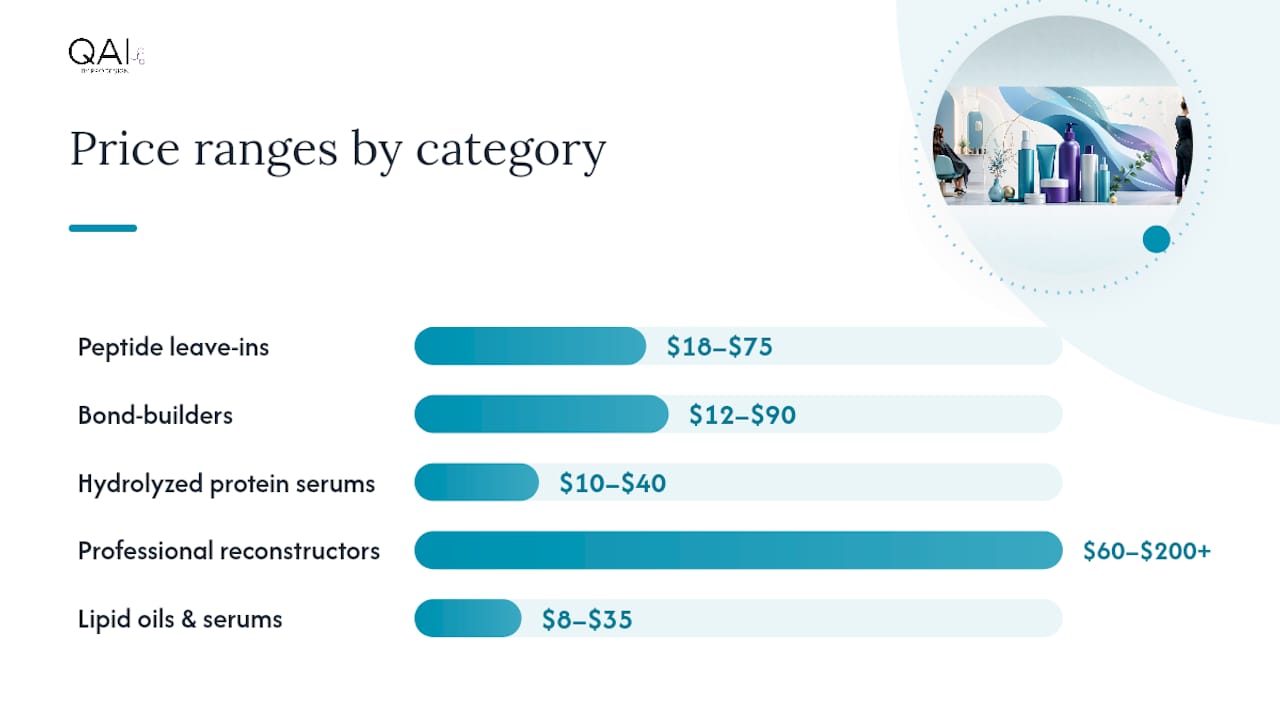
Peptide-style leave-ins work the way K18 does: small amino acid chains that theoretically slip into the damaged cortex and help rebuild broken bonds. They’re usually no-rinse, applied to damp hair before styling, and priced anywhere from $18 to $75 per bottle depending on concentration and brand positioning.
Bond-builders target disulfide bonds specifically, the sulfur-based connections that bleach and lightener attack directly. These come as both salon add-ins (mixed into color or lightener) and at-home rinse-out treatments. They’re the closest thing to a dedicated fix for chemically processed hair.
Hydrolyzed protein serums use broken-down keratin, silk, or wheat protein that’s been reduced to a molecular weight small enough to sit in or near the cortex rather than just coating the surface. Amino acids and small hydrolyzed proteins are widely used actives specifically because their reduced size lets them reach damaged areas that intact proteins can’t, according to Byrdie’s breakdown of amino acids for hair.
Professional in-salon reconstructors are the deepest intervention, typically applied in multi-step processes with heat activation and higher concentrations of active ingredients than anything sold for home use.
Supportive oils and lipid treatments round out the list, but they play a different role entirely.
- Peptide leave-ins: $18 to $75, fast application, moderate depth of repair
- Bond-builders: $12 to $90, best for chemically lightened hair specifically
- Hydrolyzed protein serums: $10 to $40, budget-friendly, good for maintenance
- Professional reconstructors: $60 to $200+ per service, deepest repair, requires salon visit
- Lipid oils and serums: $8 to $35, excellent shine and slip, no structural repair
A cheap protein serum can genuinely help with frizz and manageability day to day. What it usually can’t do is rebuild a strand that’s been lifted four levels and fried with a flat iron. That gap between surface smoothing and structural repair is where most people overspend on the wrong category, or underspend and wonder why nothing’s changing.
Which K18 Alternative Category Fits Your Damage Type?
Matching the mechanism to the damage matters more than the price tag. A $70 peptide serum wasted on the wrong damage type performs worse than a $12 protein treatment aimed correctly.
Here’s how the categories stack up against what actually matters when you’re choosing:
- Bleach and chemical damage — bond-builders win here. Disulfide bonds are the specific casualty of lightener, and rebuilding this requires an active designed to bridge sulfur bonds, not just coat the shaft. Bond rebuilders tend to outperform peptide-style products specifically on this damage type, while peptide leave-ins often show faster gains on frizz and flexibility instead.
- Daily mechanical breakage (brushing, heat styling, tight elastics) — peptide-style leave-ins or hydrolyzed protein serums perform best. The damage here is more about weakened keratin structure than broken chemical bonds, so a lighter, more frequent application usually beats one intensive treatment.
- Frizz and porosity imbalance — this is where lipid-replenishing treatments paired with a light protein serum do the most visible work, since porosity issues are often as much about the cuticle’s ability to hold moisture as they are about internal protein loss.
- Severe, multi-year damage (over-bleached, chemically relaxed, heavily heat-styled) — professional reconstructors are the only category built for this. At-home products can maintain progress but rarely reverse years of accumulated damage in a few applications.
Application methods differ just as much as the mechanisms. A K18-style leave-in is a single step: apply, style, done. Bond-builders often come as two-part kits, one step mixed into a chemical service and a second rinse-out step at home. Salon reconstructors involve saturation, heat processing, and a rinse, usually 45 minutes to over an hour per session.
Realistic timelines: expect visible surface improvement (less frizz, easier detangling) within one to three uses for most leave-in and serum products. Structural change, meaning measurably improved elasticity and reduced breakage, tends to take four to eight weeks of consistent use, which lines up with general guidance on repairing damaged hair over time. Professional reconstructor treatments can show change in a single visit, but maintaining it still requires a home routine.
Cost per use tells a different story than sticker price. A $70 leave-in used twice a week costs roughly $1.35 per use over three months. A $12 protein mask used weekly runs closer to $0.90 per use. The math favors frequent, cheaper treatments for maintenance and reserves the pricier single-step products for targeted repair.
Which Ingredients Actually Repair Hair (and Which Are Filler)?
Reading a label tells you more than any marketing claim on the front of the bottle. The actives that plausibly reach the cortex and support structural repair include peptides and peptide analogs, small hydrolyzed proteins (keratin, silk, wheat, or soy reduced to low molecular weight), maleic acid and other bond-bridging agents, and lightweight lipid-replenishers formulated to actually penetrate rather than just sit on the surface.
Peptides themselves are simply short chains of amino acids, the same basic building blocks your body uses to construct proteins throughout tissue, according to WebMD’s overview of peptides. What separates a good hair peptide formula from a mediocre one is concentration and molecular size, not the presence of the word “peptide” on the bottle.
- Look for actives named specifically: peptides, hydrolyzed keratin, hydrolyzed silk protein, panthenol paired with amino acids
- Check ingredient order: actives should sit in the first five to seven ingredients, not buried near the bottom of a 40-item list
- Be skeptical of vague claims like “strengthening complex” with no named mechanism behind it
- Watch for heavy dimethicone or cheap alcohols listed in the top three spots, which usually signals a surface-coating product rather than a repair product
- Patch-test new protein treatments if you have sensitive skin or a history of reacting to plant proteins like wheat or soy
Pro Tip: If a product’s first three ingredients are water, a cheap alcohol, and a heavy silicone, you’re looking at a smoothing product, not a repair product. Save it for maintenance days, not damage-control days.
A quick industry heuristic worth remembering: reading the top three listed ingredients tells you more about what a product actually does than any claim on the front label. If the named active is well down the ingredient list, the formula is probably delivering surface-level shine rather than internal repair.
How Do You Choose and Use a K18 Alternative Correctly?
Start with three simple self-checks. Pull a strand when it’s wet and see how far it stretches before snapping or returning to shape (poor elasticity signals internal protein damage). Drop a clean strand in a glass of water and watch whether it sinks fast (high porosity, cuticle damage) or floats (low porosity, healthier cuticle). Count visible breakage along your hairline and part over one week to establish a baseline.
- Diagnose first. Low elasticity plus fast-sinking hair points toward bond-builders or professional reconstruction. Frizz with slow-sinking hair points toward lipid-replenishing serums and lighter maintenance.
- Match category to result. Bleach-damaged hair needs a bond-builder before anything else. Daily breakage from styling responds well to a peptide leave-in used two to three times weekly.
- Apply correctly. Most leave-in treatments go on clean, towel-dried hair before any other product, then get sealed with a light conditioner or cream. Don’t layer three protein products in the same routine.
- Track for four to eight weeks. Recheck your elasticity and breakage counts, not just how hair feels, since subjective impressions shift day to day with humidity and styling.
- Escalate if nothing changes. If breakage counts haven’t improved after two months of consistent use, move to a professional-grade reconstructor or an in-salon service rather than switching between more drugstore products. Our guide to restoring hair elasticity walks through this diagnostic process in more depth.
Pro Tip: Alternate protein treatments with hydrating, protein-free conditioners. Overusing high-protein products back to back can stiffen hair and increase breakage instead of preventing it, which is the opposite of what you’re trying to fix.
How Does QAI Hair’s PolyGraft-9 Technology Compare to Other Alternatives?
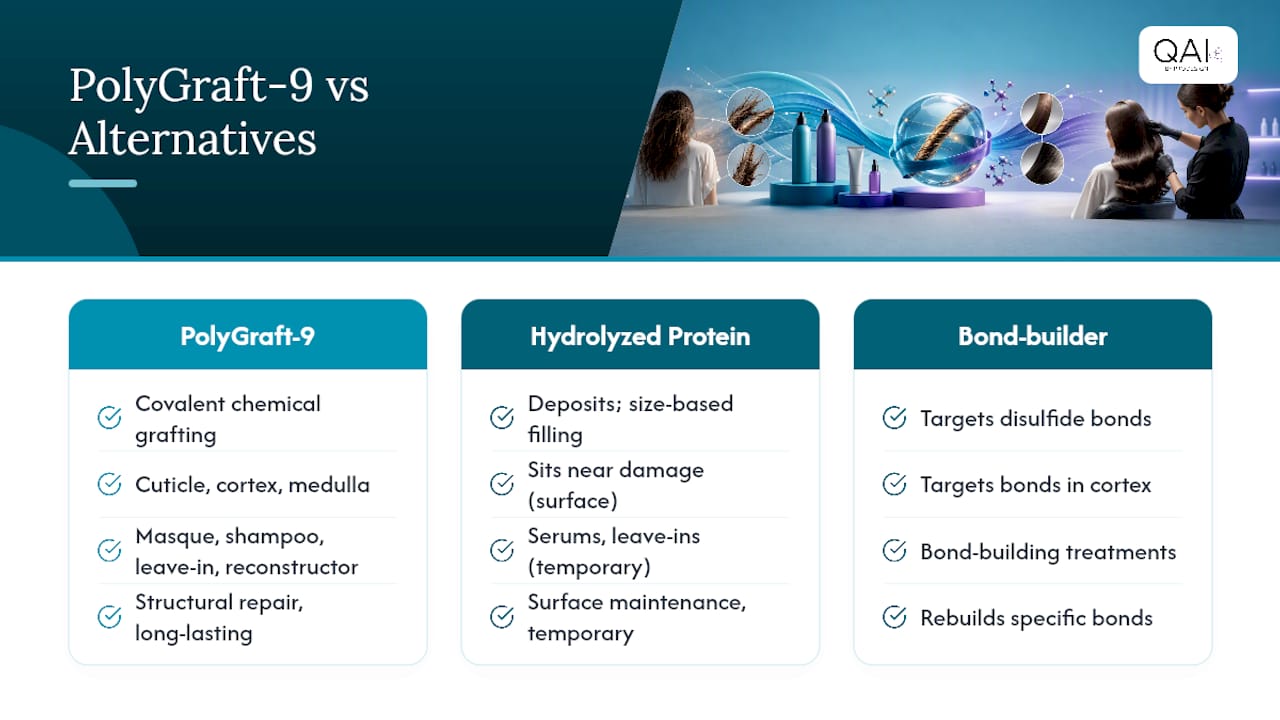
Most bond-builders and peptide leave-ins work by depositing material that sits in or near the damaged area temporarily, improving strength and feel until it washes out. QAI Hair’s approach works differently. The PolyGraft-9 Complex is described as the world’s first reactive covalent grafting polypeptide, meaning it’s formulated to chemically bond to the hair’s structure rather than simply coat or temporarily fill it.
Covalent grafting means the polypeptide forms an actual chemical bond with the hair shaft, rather than depositing on top of it the way conventional conditioning agents do. That distinction is the difference between surface maintenance and structural repair aimed at all three layers of the hair: cuticle, cortex, and medulla.
That’s a meaningfully different mechanism than a hydrolyzed protein serum, which relies on molecular size alone to sit near damaged areas, or a bond-builder, which specifically targets disulfide bonds broken by chemical lightening. Formulations may combine covalent grafting technology with ingredients like mineral-based silicones, hydroxy acids, and plant-derived lipids, aiming to address frizz, breakage, color fade, and porosity imbalance in one system rather than treating each symptom separately.
The product line includes various types designed for different depths of repair, such as rinse-out masks intended for deep structural repair, maintenance shampoos to support ongoing treatment, single-step leave-in liquids suitable for home use, and reconstructing formulas for ongoing maintenance after initial repair.
If your damage is primarily bleach or chemical processing, start with the Reconstructor Masque. If you’re maintaining hair that’s already been repaired, the Reconstructing Shampoo and QAI Liquid Hair work well in rotation. Readers who want the underlying chemistry explained in more technical detail can read the full breakdown of covalent polypeptide technology directly from QAI Hair.
What Do Users and Stylists Say About K18 Alternatives?
Consumer coverage of budget dupes has grown alongside K18’s popularity, and the feedback is consistent on one point: cheaper masks often deliver fast surface smoothing, but not always the deeper repair that pricier or professional-grade options claim. One widely shared beauty piece tested a $20 hair treatment against K18 and found it delivered noticeable softness quickly, though the reviewer noted the difference showed up mainly in feel and shine rather than measurable strength recovery.
That pattern shows up across most user experiences with drugstore-level alternatives. People report real improvements in manageability and frizz within a wash or two, especially on hair that wasn’t severely damaged to begin with. Where reviews get more mixed is on hair with heavy bleach history or years of heat damage, where users consistently describe needing either a professional treatment or a longer commitment to a home routine before seeing real change in breakage.
Stylists tend to echo this in professional forums and salon consultations: they’ll recommend an at-home peptide or protein product for maintenance between visits, but reach for a professional reconstructor when a client’s hair has visible, structural breakage rather than just dullness or frizz. The consensus, informal as it is, lines up with the damage-type-first approach: match the intensity of the product to the intensity of the damage, and don’t expect a $15 serum to undo three years of bleach.
Where Can You Buy K18 Alternatives?
Availability splits fairly cleanly between drugstore and prestige retail for budget options, and professional-only channels for salon-grade reconstructors. Peptide leave-ins and hydrolyzed protein serums show up in mass retailers, beauty specialty stores, and online marketplaces, usually with enough reviews to gauge general satisfaction before buying.
Bond-builders occupy a middle tier. Some versions are sold directly to consumers for home use, while the stronger salon formulations are only available through licensed stylists as part of a color or lightening service. If you’re trying to replicate an in-salon bond treatment at home, check the label carefully, since the retail version is almost always a diluted formula compared to what a stylist uses professionally.
Professional-grade reconstructors are typically sold both direct-to-consumer online and through professional stylists who incorporate them into in-salon services. Buying directly from a brand’s own site, rather than a third-party marketplace, is generally the safer bet for anything claiming a proprietary or patented active ingredient, since counterfeit or diluted versions circulate on unauthorized resale platforms. The brand’s product collection and its individual product pages list current formulations and application guidance directly.
Are K18 Alternatives Cruelty-Free and Environmentally Conscious?
Cruelty-free status and environmental impact vary widely across this category, and neither is guaranteed just because a product markets itself as “clean” or “natural.” Hydrolyzed proteins can be sourced from plant material (wheat, soy, rice) or animal byproducts (keratin from wool, collagen from animal sources), so readers avoiding animal-derived ingredients need to check the specific protein source listed on the label, not just the word “protein.”
Packaging is where the bigger environmental differences show up. Multi-step bond-builder kits and professional reconstructor systems typically use more plastic per treatment than a single leave-in bottle, simply because they involve more components. Buying concentrated formulas that get diluted at point of use, rather than pre-diluted retail versions, generally reduces packaging waste per application.
For readers prioritizing cruelty-free formulation specifically, checking for third-party certification logos (rather than relying on brand claims alone) remains the more reliable verification method, since “cruelty-free” isn’t a regulated term in most cosmetic markets. Some formulations lean on plant-derived lipids and mineral-based silicones rather than heavier synthetic emollients, contributing to a lighter-weight, non-greasy finish compared to traditional oil-based conditioning agents.
Balancing Price, Convenience, and Real Repair
The instinct to grab the cheapest protein serum on the shelf makes sense until you realize damage type, not price, decides whether a product works. A $12 serum matched correctly to mild breakage beats a $70 leave-in applied to the wrong problem every time.
DIY products earn their place for maintenance and mild-to-moderate damage. Once breakage is visible at the hairline or hair has been through multiple bleach sessions, a professional rebuild stops being optional and starts being the only route that makes financial sense long term.
Track elasticity and breakage counts, not how hair feels on a given Tuesday. Feel is unreliable. Numbers aren’t.
— Kollin Gessler
Start Your Repair Routine With QAI Hair
Most K18 alternatives ask you to guess whether a temporary coating will hold up against real structural damage. QAI Hair’s PolyGraft-9 Complex is built to chemically bond to the hair shaft instead of just sitting on top of it, which means you’re treating the actual damage rather than masking it until the next wash.

If your hair has visible bleach damage or breakage, start with the QAI Tiger Reconstructor Masque for the deepest repair pass. For daily maintenance between treatments, pair it with the QAI Tiger Reconstructing Shampoo. If you want a single-step, leave-in option closer to what K18 offers, QAI Liquid Hair applies the same PolyGraft-9 technology in a lighter, everyday format. Readers dealing with severe or long-term damage can also explore QAI Hair’s professional chemical corrective repair services for an in-salon rebuild. Pick the product that matches your damage type, apply consistently for four to eight weeks, and track your results as you go.
Sources
FAQ
Is there anything comparable to K18?
Yes. Bond-builders, peptide-style leave-ins, and hydrolyzed protein serums all use mechanisms comparable to K18’s peptide approach, though effectiveness depends on matching the mechanism to your damage type. Professional reconstructors, including QAI Hair’s Tiger Reconstructor line, offer a comparable or deeper repair mechanism through covalent grafting technology.
Does anything work as well as K18?
Several categories can work as well or better depending on the damage. Bond-builders tend to outperform peptide leave-ins specifically on bleach and chemical damage, while covalent grafting approaches like QAI’s PolyGraft-9 are designed to chemically bond to the hair rather than temporarily coat it.
Is there a cheaper version of K18?
Hydrolyzed protein serums and drugstore peptide leave-ins offer cheaper alternatives, often priced between $10 and $40, and can deliver real improvement in frizz and manageability within a few uses. They typically don’t match the depth of repair from a professional reconstructor on severely damaged hair.
What is a good dupe for the K18 molecular spray?
A hydrolyzed protein or peptide-based leave-in with actives listed near the top of the ingredient panel is the closest budget dupe category. For deeper structural repair beyond surface smoothing, QAI Liquid Hair offers a leave-in format built on covalent grafting technology rather than surface deposition alone.

