


Covalent grafting polypeptide technology forms stable chemical bonds with damaged hair to rebuild internal structure and prolong color retention. Unlike coatings that sit on the cuticle until the next shampoo, these polypeptides bond directly at broken disulfide sites inside the fiber. The practical result for a salon chair: fewer breakages, measurably stronger strands, and color that holds through more wash cycles.
QAI Hair built its PolyGraft-9 Complex around this exact chemistry, giving stylists a working example of what “permanent” repair actually looks like in a bottle.
- Repairs disulfide breaks at the source, not just the surface
- Improves tensile strength in bleached and over-processed hair
- Extends color vibrancy by sealing the cortex against fade
- Implemented commercially in QAI Hair’s PolyGraft-9 Complex
Key Takeaways
Covalent grafting polypeptide technology outperforms surface conditioners because it forms permanent chemical bonds at broken disulfide sites rather than temporary surface coatings.
| Point | Details |
|---|---|
| Mechanism requires two acceptors | Michael acceptor groups must come in pairs to bridge broken disulfide sites left by bleaching. |
| Binding beats surface conditioners | Reactive keratin derivatives showed up to 3.6x better binding affinity to bleached hair in lab testing. |
| Results need remaining substrate | Covalent bonding needs free thiols to react with; severely degraded fiber may not fully respond. |
| Maintenance runs monthly to bimonthly | Patent data shows structural improvements persisting roughly two months before reapplication is needed. |
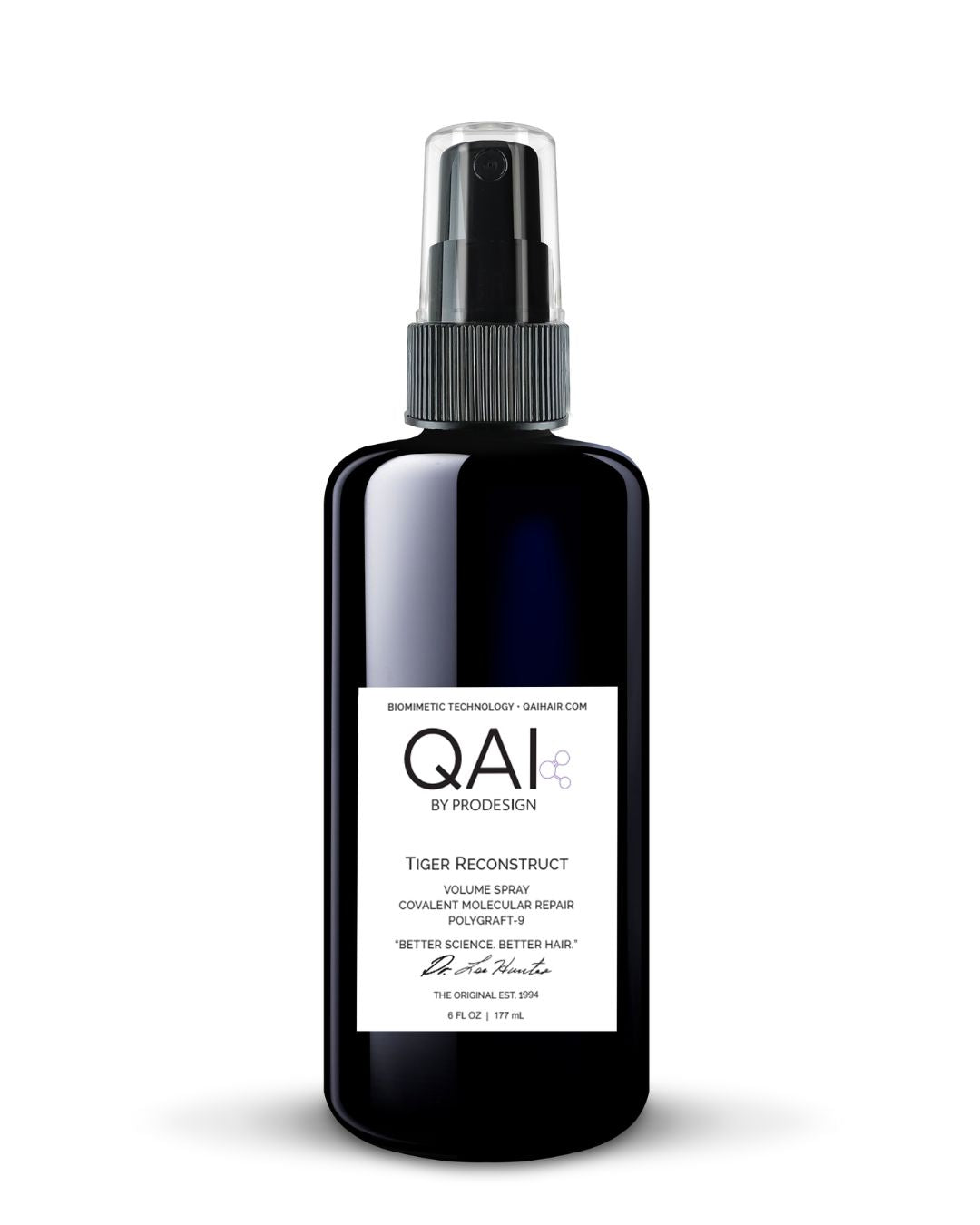
| QAI Hair implements this chemistry | QAI Tiger Reconstruct applies the PolyGraft-9 Complex for salon-grade covalent repair and color locking. |
What Is Covalent Grafting and How Does It Bond to Hair?
The chemistry behind covalent grafting is called Michael thiol click chemistry, and it explains why this approach outlasts anything that relies on static cling or surface deposition. Bleaching and chemical processing snap disulfide bonds inside the cortex, leaving behind free thiol groups, essentially open chemical handles with nothing to hold onto. A reactive polypeptide carrying functional Michael acceptor groups finds those exposed thiols and forms a new covalent bond, chemically identical in strength to the disulfide bond that was lost.
One detail separates effective formulations from cosmetic ones: the polypeptide needs at least two acceptor groups, not one. Bleaching breaks disulfide bonds in pairs, so a single-acceptor molecule can only latch onto one side of the gap and gets rinsed away. An even-numbered, multi-acceptor architecture is what lets the polypeptide bridge both broken ends and restore mechanical continuity across the break.
The mechanism, documented in peer-reviewed research, depends on functional Michael acceptor groups reacting with free thiols on damaged hair, with at least two acceptors required to close a broken disulfide gap.
Polypeptide length and acceptor placement also determine how well the molecule integrates into the cuticle versus the deeper cortex. A U.S. patent covering functionalized polypeptides for hair treatment describes this multi-acceptor design directly, and separate work on protein disulfide isomerase-assisted grafting found that enzyme-facilitated bonding restored measurable tensile strength and thermal stability in over-bleached samples. Confocal microscopy in related studies confirms these polypeptides don’t just sit on the surface, they accumulate inside the cuticle where the damage actually lives.
Does Covalent Bonding Really Outlast Surface Conditioners?
Surface conditioners work through electrostatic attraction, a temporary cling between positively charged ingredients and negatively charged damaged hair. That bond breaks with the first shampoo. Covalent bonds don’t, because they’re chemically the same class of bond holding the rest of the hair fiber together.
The performance gap shows up clearly in lab data. Reactive keratin derivatives demonstrated up to 3.6 times better binding affinity to bleached hair than non-reactive alternatives, with confocal microscopy confirming the material stayed put in the cuticle rather than washing off. That’s the difference between a treatment that fades by Thursday and one still doing its job at the next appointment.
In salon terms, this translates into outcomes stylists can actually observe:
- Noticeably fewer mechanical breakages during blow-drying and combing
- Increased tensile strength in chemically compromised sections
- Better color retention across more wash cycles
- More even porosity across previously patchy, over-processed lengths
Covalent grafting has real boundaries, though. The chemistry needs free thiols to react with, so it depends on hair that still has damaged but present protein substrate. If a section of hair has lost so much structural material that there’s nothing left to bond to, no reactive chemistry will rebuild it from nothing. Thiols are also prone to oxidation over time, which is why formulation strategies like thiol protection during processing matter as much as the base chemistry itself.
Which Clients and Services Benefit Most From This Treatment?
Covalent polypeptide treatments earn their keep on clients whose hair has real structural damage to reconnect, not just cosmetic frizz. Prioritize these candidates first:
- Clients with heavily bleached or double-processed hair showing visible porosity
- Color clients who complain about fade happening faster than expected
- High-porosity hair that won’t hold moisture or product evenly
- Anyone booking a formaldehyde-free smoothing service who also needs structural repair
The treatment works as a standalone reconstructing service, but it slots just as naturally into a color workflow, applied before lightening to pre-strengthen the fiber, or after color to lock pigment in place. It also pairs with porosity-leveling steps ahead of any chemical service, and with Controlled Effects smoothing for clients who want both structural repair and a sleek finish in one visit.
Pro Tip: Run a quick strand test before committing to a full reconstructing service. If the hair snaps with almost no tension, there may not be enough remaining protein substrate for covalent bonding to make a visible difference.
Watch for red flags: active scalp irritation, chemical burns, or hair so degraded that no cuticle structure remains. In those cases, address the underlying issue before layering on any bonding treatment.
How Long Does Application Take and How Often Should You Reapply?
Contact time drives results with this chemistry, so rushing the process undercuts the outcome. Based on patent documentation and clinical evidence:
- Apply the reconstructing formula to clean, towel-dried hair, focusing on mid-lengths and ends where damage concentrates
- Allow a contact time of roughly 15 to 30 minutes minimum, extending longer for severely bleached or resistant hair
- Consider a double application on the most compromised sections for deeper cortex penetration
- Rinse thoroughly and follow with a low-pH sealing step to close the cuticle
The same patent documentation notes that structural improvements from a single treatment can persist for roughly two months, which sets a realistic maintenance rhythm.
- Schedule reapplication somewhere between monthly and every two months, depending on how aggressively the client colors or heat-styles
- Recommend sulfate-free shampoos between visits to protect the new covalent bonds from premature stripping
- Set heat tools to moderate temperatures and always use a protectant, since excess heat accelerates thiol oxidation
- Check results with a simple wet strand-stretch test and a visual porosity check at the next visit
What Should Stylists Tell Clients About Safety and Results?
Treat this like any professional chemical service: check the safety data sheet, patch test new clients, keep the work area ventilated, and control contact time rather than eyeballing it. Get informed consent before any service involving reactive chemistry, especially on already-compromised hair.
On claims, stick to what the evidence actually supports. You can accurately say the treatment forms covalent bonds at damage sites, that peer-reviewed studies show improved binding affinity, and that a patent documents the mechanism. Avoid absolute language like “repairs all damage permanently,” since the chemistry depends on remaining thiol substrate and can’t rebuild fiber that’s genuinely gone.
- Confirm SDS review and patch testing before first-time use
- Verify formaldehyde-free claims against the actual product label, not just marketing copy
- Communicate contact time and aftercare clearly so results hold between visits
What Are These Polypeptides Actually Made Of?
A reactive covalent grafting polypeptide isn’t a single molecule so much as an engineered chain of amino acids built with specific functional groups attached at calculated points along its length. The backbone provides structural compatibility with keratin, the dominant protein in hair, while the attached Michael acceptor groups act as the reactive sites that seek out and bond with exposed thiols.
Polypeptide length matters more than it might seem. Chains that are too short struggle to bridge the physical distance between two broken disulfide ends. Chains that are too long can have trouble penetrating past the cuticle into the cortex, where much of the structural damage actually occurs. Formulators balance both constraints, along with placement of the acceptor groups, to get molecules small enough to penetrate and long enough to reconnect broken sites.
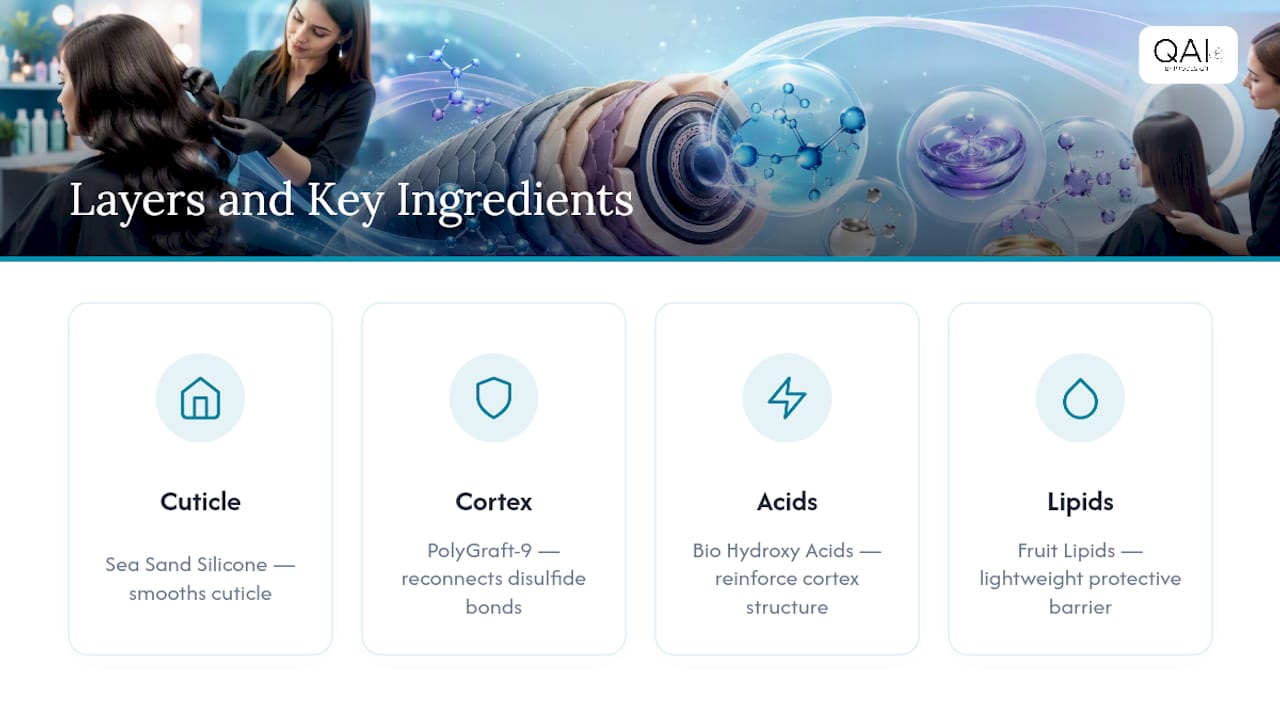
Beyond the reactive polypeptide itself, formulations typically combine supportive ingredients that address different structural layers. QAI Hair’s approach pairs PolyGraft-9 with Sea Sand Silicone, Bio Hydroxy Acids, and Fruit Lipids, each targeting a different layer of the hair, from cuticle smoothing to cortex-level reinforcement to a lightweight protective lipid barrier that doesn’t leave residue. That layered design reflects a broader trend in biomimetic hair chemistry: building formulas that mimic the hair’s own protein architecture rather than simply coating over damage.
Is Covalent Polypeptide Chemistry Sustainable?
Reactive polypeptide chemistry has a structural sustainability advantage that surface treatments don’t: durability reduces product turnover. When a bond lasts through dozens of wash cycles instead of one or two, clients need fewer bottles, fewer salon visits solely for touch-ups, and generate less packaging waste over a year of hair care.
The raw materials matter too. Polypeptides used in this chemistry are typically derived from protein sources rather than petroleum-based polymers, aligning with a broader shift in personal care toward bio-derived ingredients. Formulation strategies that rely on precise, small-scale reactive chemistry, rather than heavy loads of silicone or synthetic film-formers, also tend to require less total product mass to achieve a visible result, since the bonding does the structural work rather than a thick coating.
None of this makes any single product a full sustainability solution on its own. But the underlying chemistry, targeted covalent bonding instead of repeated surface masking, points toward a lower-waste model for hair repair than the reapply-every-wash approach that’s dominated the category for decades. For salon owners fielding more sustainability questions from clients, that’s a legitimate answer grounded in how the chemistry actually behaves, not a marketing gloss layered on top of it.
What This Technology Gets Right, and Where the Hype Runs Ahead of the Science
The evidence for covalent grafting is genuinely strong, stronger than most of what circulates in professional hair care under the banner of “bond building.” A patent describing multi-acceptor polypeptide design, peer-reviewed binding data showing measurable gains in bleached hair, and enzyme-assisted grafting studies restoring tensile strength are not marketing claims. They are chemistry with a mechanism you can point to and a citation trail you can follow.
Where I think the industry oversells this category is in implying that any bond-building product delivers this kind of permanence. It doesn’t. Covalent bonding requires free thiols to react with, and plenty of “bonding” formulas rely on ionic or hydrogen bonding that washes out on schedule. Stylists should ask what mechanism a product actually uses before repeating a supplier’s language to clients.
The other overlooked point: assessing remaining fiber substrate before treatment matters more than most protocols acknowledge. If there’s nothing left to bond to, no chemistry rebuilds it. Check the hair first. Then reach for the right tool.
— Kollin Gessler
Bring Covalent Polypeptide Technology Into Your Salon Workflow
QAI Hair turns the chemistry covered above into a product a stylist can actually shelve and use, rather than just a mechanism to explain to clients. QAI Tiger Reconstruct is built around the PolyGraft-9 Complex, the reactive covalent grafting polypeptide at the center of QAI Hair’s system, paired with Sea Sand Silicone, Bio Hydroxy Acids, and Fruit Lipids to work across the cuticle, cortex, and surface layer in one service.
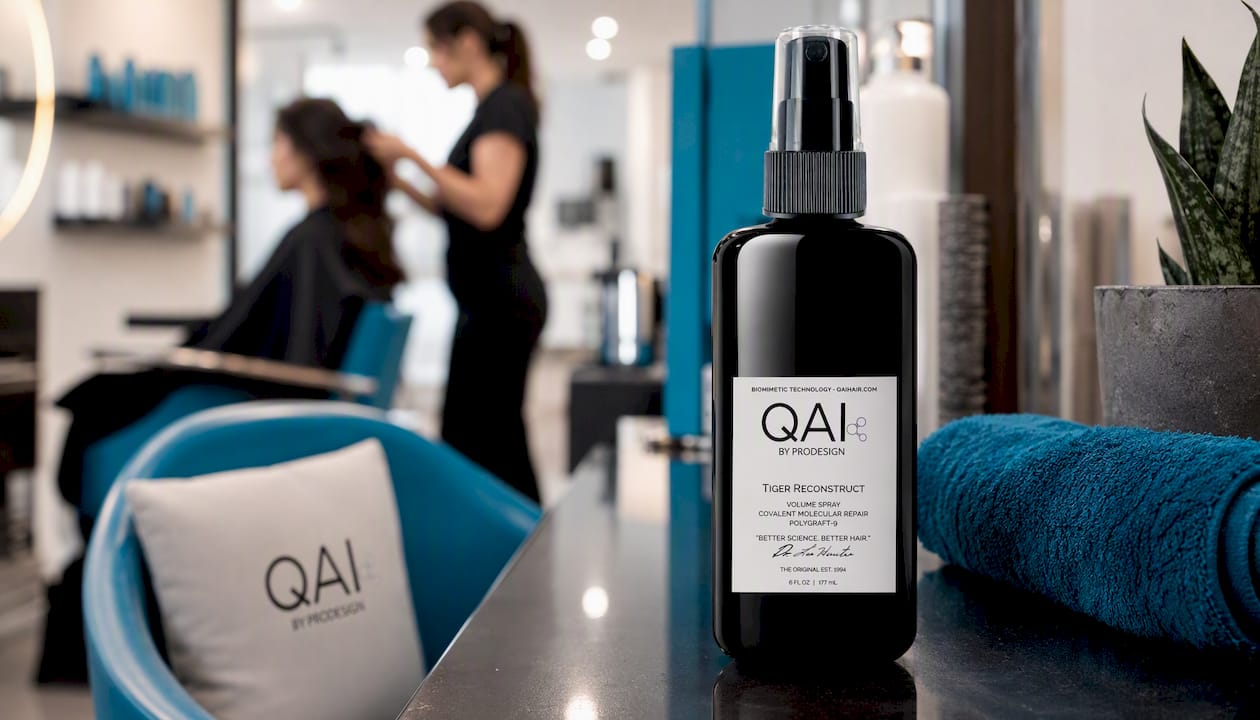
It fits into a salon workflow a few different ways: as a standalone reconstructing treatment for heavily bleached clients, as a pre-color strengthening step, or bundled into the Controlled Effects tinted and bleached formula system for clients getting a full color and smoothing service in one visit. Pair it with QAI Tiger Reconstructing Shampoo at home to protect the covalent bonds between salon visits.
If you’re ready to add real bond repair to your service menu, visit the QAI Tiger Reconstruct product page and check current formats and professional kit sizing before your next reconstructing appointment.
Sources
- PubMed entry describing covalent polypeptide grafting mechanism
- Reactive keratin derivatives: improved binding to hair fibers (ScienceDirect / PubMed abstract)
- Functionalized polypeptides useful in hair treatment (U.S. Patent 11,896,705)
- Protein disulphide isomerase-mediated grafting of cysteine-containing peptides onto over-bleached hair

