


You cannot permanently “close” a damaged cuticle, but you can flatten and protect it with a repeatable routine: pH-balanced cleansing, a bond-building mask, a lightweight lipid sealer, and heat protection before styling. That combination smooths the hair’s outer layer temporarily, which is really what “sealing” means. For longer-term structural repair, a covalent grafting polypeptide treatment like QAI Hair’s system goes further than a surface coat.
TL;DR:
- Using pH-balanced shampoos and bond-building masks is essential for internal repair before applying surface sealers to prevent dirt and product buildup.
- Acidic formulas help flatten cuticle scales, but surface sealers like silicones only fill gaps temporarily without fixing structural damage.
- Covalent grafting polypeptide treatments like QAI Hair’s PolyGraft-9 form internal bonds, offering longer-lasting smoothing and structural repair.
- Porosity testing guides product choice: low porosity benefits from lightweight lipid barriers, while high porosity requires heavier oils and frequent bond repair.
- Sealers cannot permanently close a damaged cuticle; ongoing maintenance and internal fiber repair are necessary for lasting hair health.
How Do You Seal the Hair Cuticle Step by Step?
Sealing works in layers, and the order matters more than most people realize. Skip a step or do them out of sequence and you end up locking dirt or old product under a coat of silicone instead of actually smoothing anything.
Start with a quick porosity check (drop a clean strand in water; if it sinks fast, you’re dealing with high porosity and raised cuticles). Detangle gently with fingers or a wide-tooth comb before any wash. Wet hair is at its most fragile, and rough detangling now undoes half of what the rest of the routine is trying to fix.
- Cleanse with an acidic or pH-balanced shampoo. This removes product buildup and oil without pushing hair further into alkaline territory, which is what causes cuticle scales to lift in the first place. A reconstructing shampoo formulated for damaged strands works here instead of a standard clarifying wash.
- Apply a concentrated mask or bond-builder. Rake it through section by section, let it sit 5 to 15 minutes depending on the formula, and rinse with cool to lukewarm water. This is where internal repair happens, not just surface polish.
- Apply a heat protectant before any hot tool touches your hair. Skipping this step is the single most common reason cuticle damage gets worse instead of better.
- Finish with a lightweight sealer or leave-in. Apply to damp or dry hair, focusing on mid-shaft to ends where cuticles have taken the most cumulative wear.
The layering rule that trips people up: heavier oils go on damp hair before a leave-in, never after a silicone-based finishing product, or you’ll get a greasy film that repels everything applied on top of it.
Pro Tip: If your hair feels waxy or looks dull two days after a wash, you’re layering too many rich products. Drop back to a lightweight sealer only, and save the heavy oils for once a week.
What Does “Sealing the Cuticle” Actually Mean?
The cuticle is the hair’s outer shell, made of overlapping keratin cells stacked like roof shingles. When they lie flat, they control how much moisture escapes and how much friction hair generates against itself, which is why flat cuticles look shinier and feel smoother. Chemical processing and heat lift those scales, and the structure becomes more porous as a direct result.
pH is the mechanism most people get wrong. Alkaline formulas, the kind used in bleach and some relaxers, swell the hair shaft and lift the scales open. Acidic formulas do the opposite: they help scales contract and lie flatter against the shaft. That is why a post-treatment acidic rinse is standard practice in professional color services, not a folk remedy.
Sealers themselves don’t rebond a lifted scale to the shaft. They coat it, filling gaps with a hydrophobic layer or a polymer matrix that mimics the smoothness of an intact cuticle.
Silicones and conditioning polymers reduce friction and temporarily limit moisture exchange, and that’s the entire mechanism behind most “instant shine” claims on a bottle. Covalent grafting technology works differently: instead of coating the surface, it forms new molecular bonds inside the fiber, which is a structural fix rather than a cosmetic one.
Which Ingredients Actually Seal or Smooth the Cuticle?
Not every “sealing” ingredient does the same job, and picking the wrong one for your hair type is how buildup happens. Here’s how the major categories stack up:
- Silicones and polysiloxanes deliver the most reliable shine and friction reduction of any topical category, and they work well before heat styling since they create a slip layer between the hair shaft and a hot tool.
- Natural oils (coconut, olive, almond) penetrate better on high-porosity strands with raised cuticles, but they sit heavy on low-porosity hair and can leave it looking flat or greasy within a day.
- Bond builders and protein treatments repair the internal fiber rather than just coating it, but overuse causes protein overload, leaving hair stiff, brittle, and prone to snapping instead of stretching.
- Rice water rinses supply amino acids that give a temporary shine boost, and the same protein overload risk applies here if used more than once or twice a week.
- Lightweight lipid barriers and biomimetic technologies smooth hair without the grease penalty of heavier oils, which is why most current heat-styling protection advice has shifted away from thick oils toward these thinner formulas.
Pro Tip: If you can’t remember the last time you clarified your hair, that’s your answer for why sealers stopped working. Buildup blocks absorption before it blocks anything else.
QAI Hair’s approach sits in that last category but goes a step further. Instead of only laying a lipid film on top, the PolyGraft-9 complex grafts into the fiber itself, which is a meaningfully different mechanism than a rinse-out silicone.
Which Sealing Routine Fits Your Hair Porosity?
Porosity determines almost everything about which sealer works and which one backfires. A simple strand test tells you where you land: strands that float are low porosity, strands that sink slowly are medium, and strands that sink immediately are high porosity.
- Low porosity: Cuticles sit tight and resist absorption. Use mild heat during masking to coax them open slightly, stick to lightweight lipid barriers, and skip heavy oils and frequent protein treatments, which just sit on top and build up.
- Medium porosity: This is the balanced middle ground. A weekly mask and a light sealing product most days keeps things steady without overcorrecting in either direction.
- High porosity: Cuticles are already raised and losing moisture fast. Heavier oils and richer masks work better here, and trichologists generally recommend matching heavier sealants to higher porosity hair. More frequent sealing, plus a bond-building treatment, addresses both the surface and the structural side of the damage.
What Can’t Sealing Fix, and What Myths Should You Ignore?
Sealing is maintenance, not a cure. It cannot permanently glue a damaged cuticle shut. Each wash, each heat styling session, and each chemical service reopens the same vulnerability, which is why upkeep never really ends.
- The cold-water-rinse myth: rinsing with cold water doesn’t meaningfully flatten cuticles. Acidity, not temperature, is what actually pulls scales tighter.
- Overusing protein or heavy oils backfires by making hair either too stiff or too weighed down, undoing the smoothness you’re chasing.
- High heat without protectant causes damage faster than any sealer can compensate for, regardless of price point.
- Repeated alkaline services leave cumulative wear that a rinse-out sealer can mask but never fully erases.
If hair snaps easily, won’t hold a curl, or looks damaged even after a careful routine, that’s a sign to bring in a professional for structural correction rather than layering on more products at home.
QAI Hair’s Covalent Grafting Approach to Cuticle Repair
Dr. Lee Hunter built QAI Hair after 37 years in personal care research, including leadership roles at Clairol and Redken, and the covalent grafting polypeptide technology he developed works differently from a rinse-out silicone. PolyGraft-9 forms new bonds inside the hair fiber rather than sitting on top of it, which targets the structural side of damage that topical sealers can’t touch.
Here’s how the three products slot into the routine covered above:
- QAI Tiger Reconstructing Shampoo replaces a standard cleanser in step one, clearing buildup without stripping the fiber.
- QAI Tiger Reconstructor Masque takes the place of a generic bond-builder in step two, delivering concentrated repair during the mask stage.
- QAI Liquid Hair finishes the routine as the lightweight sealer, smoothing strands without the grease that heavier oils leave behind.
Expect smoother strands, more even porosity, and better color retention after consistent use, since a leveled cuticle holds pigment more evenly than a rough, porous one.
Quick Checklist to Seal and Protect Your Hair Cuticle
- Run a porosity test before changing anything.
- Switch to a pH-balanced or reconstructing shampoo.
- Deep-condition weekly with a bond-building mask.
- Apply heat protectant every time before styling.
- Finish with a lightweight sealer daily, and clarify every two to three weeks to prevent buildup.
Why Most Cuticle Advice Oversells What Sealing Can Do
Most cuticle content promises a permanent fix and delivers a temporary one, and that gap is where a lot of frustration comes from. The honest version is less dramatic: you’re managing an ongoing state, not solving a problem once and moving on. Readers who understand that going in tend to stick with a routine longer, because they’re not waiting for a miracle that was never coming.
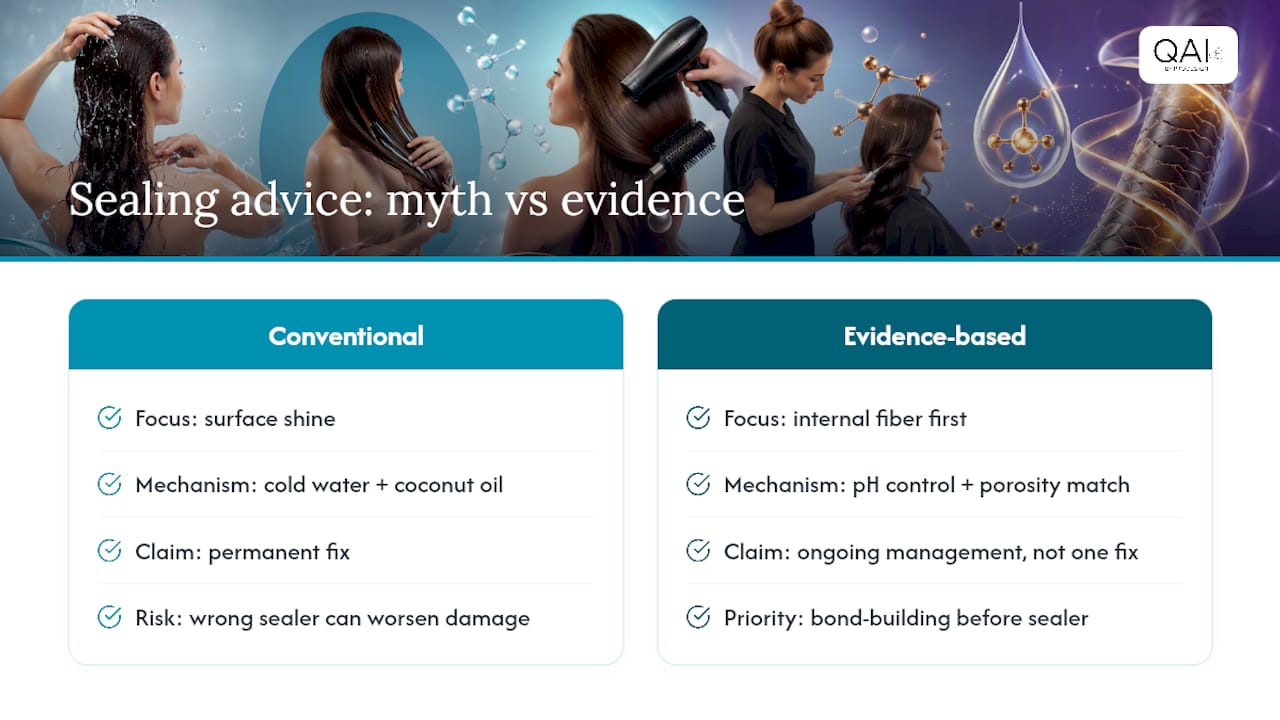
The conventional advice fixates on cold water and coconut oil, two things with a weak mechanistic basis compared to pH control and porosity matching. Acidity does the real work of temperature. And a sealer chosen for the wrong porosity often causes more visible damage than doing nothing at all.
If there’s one thing to prioritize, it’s fixing the internal fiber before obsessing over shine. A bond-building step, whether that’s a drugstore mask or a covalent grafting treatment, addresses the structural cause. Surface sealers are the finishing touch, not the foundation. Get that order backwards and you’re just polishing damage instead of repairing it.
— Kollin Gessler
Ready to Move Past Surface-Level Sealing?
Silicone sprays and rinse-out oils smooth hair for a wash cycle or two, then you’re back where you started. QAI Hair takes a different approach: instead of coating the cuticle, the covalent grafting polypeptide technology in every formula bonds inside the hair fiber, which means the improvement in smoothness and porosity leveling holds up longer than a topical sealer ever could.
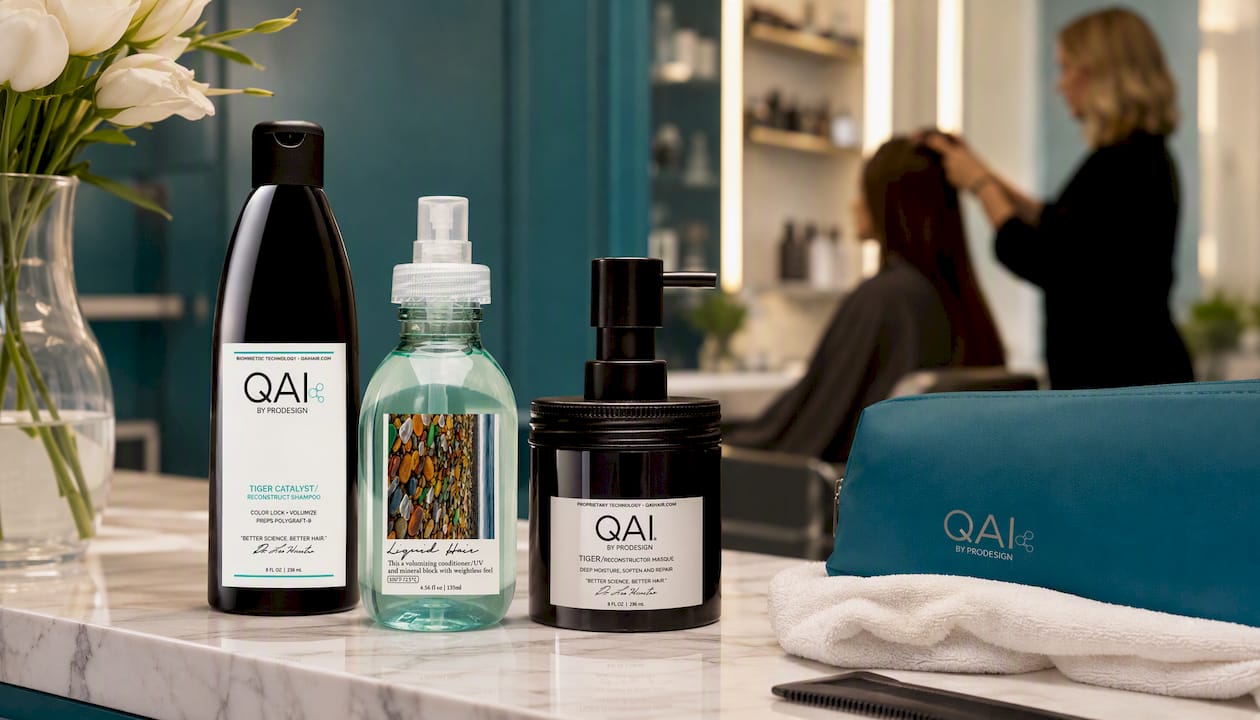
For salon owners and stylists, that translates into treatments clients notice weeks later, not just at the shampoo bowl. For anyone managing damaged or color-treated hair at home, it means fewer products layered on top of each other trying to compensate for surface-level fixes. Start with the QAI Tiger Reconstructing Shampoo and QAI Tiger Reconstructor Masque to rebuild internal strength, then finish with QAI Liquid Hair for a weightless seal. Order the set and give your next wash day a real structural upgrade instead of another temporary coat.

