


You can check your hair porosity at home in under five minutes using three quick tests. The most reliable signals come from the spray (absorption) test and the strand feel test. The float test is worth doing, but treat it as a supporting clue, not a verdict on its own.
Here’s what each result broadly means:
- Spray test: water beads and sits — low porosity (cuticle is tight, resists moisture)
- Spray test: water absorbs immediately — high porosity (cuticle is open or damaged)
- Strand feel: smooth root-to-tip — low to medium porosity
- Strand feel: rough or bumpy — high porosity (raised cuticle scales)
- Float test: strand sinks within a few minutes — likely high porosity; floats longer — likely low
Key Takeaways
The spray test and strand feel are the most reliable at-home porosity signals; combine them with behavioral observation across multiple wash days for the most accurate result.
| Point | Details |
|---|---|
| Lead with spray and feel | These two tests give more consistent results than the float test alone. |
| Prep matters | Clarify hair, use distilled water, and test at room temperature for accurate readings. |
| Test multiple zones | Porosity varies across the head; sample crown, nape, and temple separately. |
| Porosity is dynamic | Retest every 6–12 months or after any chemical service, as porosity shifts over time. |
| QAI Tiger Reconstructor Masque | A professional-grade reconstructor for high-porosity repair and porosity leveling. |
How to do a hair porosity test at home: three reliable methods
The three tests below work together. Run all three on the same day for the clearest picture.
1. Spray (absorption) test
This is the most repeatable at-home method. TheGlossyLocks documents a two-timestamp spray protocol that raises accuracy significantly over a single observation.
Steps:
- Start with clean, completely dry hair. No styling products.
- Lay a single strand flat on a dark surface or hold it taut.
- Hold a spray bottle about six inches away and mist two or three small droplets onto the strand.
- Observe immediately: do the droplets bead up, or does the water absorb on contact?
- Wait three minutes. Check again.
What you see:
- Droplets bead and stay: low porosity
- Droplets absorb within 30 seconds: high porosity
- Droplets absorb slowly over 1–3 minutes: medium porosity
2. Strand feel / finger test
Run two fingers from root to tip along a single, clean, dry strand.
- Smooth all the way: cuticle is flat, likely low porosity
- Slightly textured: medium porosity, cuticle is moderately raised
- Rough, bumpy, or catches your fingers: high porosity, cuticle scales are lifted or damaged
This test takes ten seconds and costs nothing. It’s also the one most people skip, which is a mistake.
3. Clean-strand float test
Fill a clear glass with room-temperature water. Drop in two or three clean, dry strands.
- Watch for 2–10 minutes.
- Sinks quickly (under 2 minutes): high porosity
- Floats for several minutes then slowly sinks: medium porosity
- Still floating after 10 minutes: low porosity
Healthline recommends treating float results as one clue among multiple behavioral observations, not a standalone diagnosis. Surface tension, strand thickness, and residual oils can all skew the result.
Pro Tip: If your spray test and strand feel agree but your float test contradicts them, trust the spray and feel. Behavior-based signals are more consistent than a single physical measurement.
How to prepare your hair for an accurate porosity reading
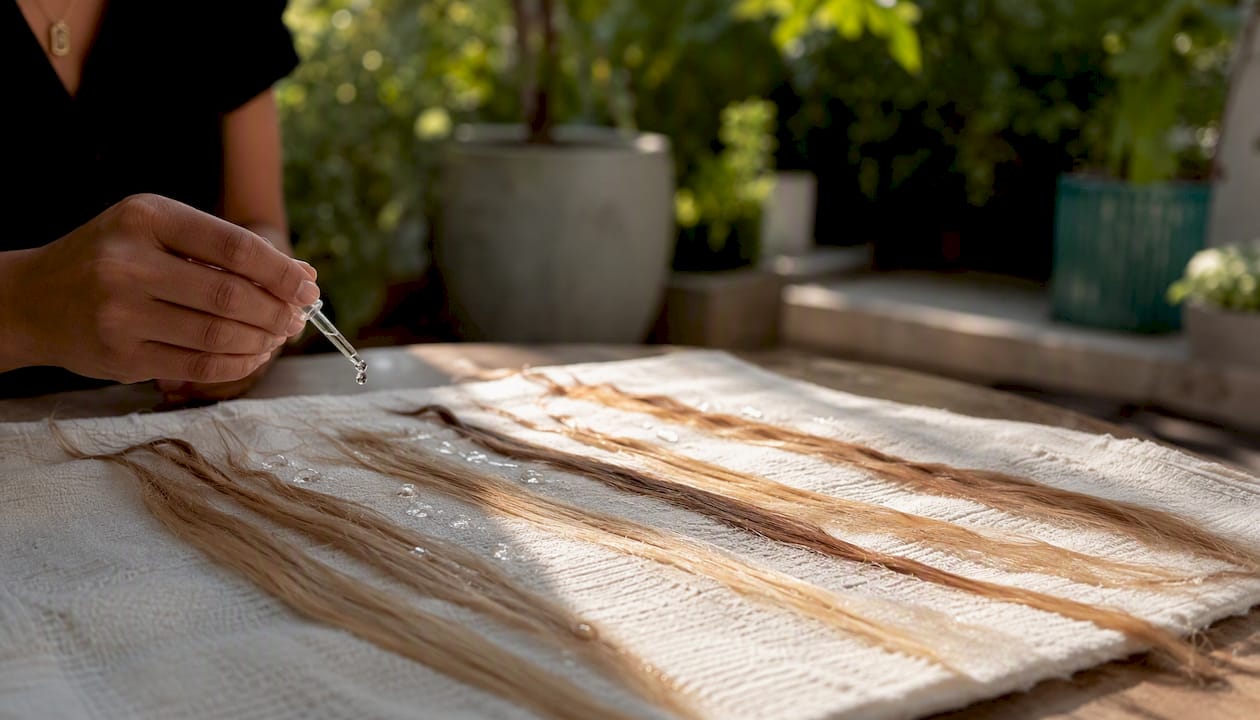
Skipping prep is the most common reason home tests give confusing results. Product residue, hard water minerals, and even humidity in the room can all shift what you observe.
Before you test:
- Wash with a clarifying shampoo, or shampoo twice with your regular formula, to strip buildup.
- Rinse with filtered or distilled water if your tap water is hard. Mineral deposits coat the cuticle and mimic low-porosity behavior.
- Dry hair completely before any test. Damp hair absorbs water regardless of porosity.
- Wait at least 48 hours after a chemical service (color, bleach, relaxer, keratin treatment). Fresh chemistry temporarily disrupts the cuticle and produces unreliable readings.
Which strands to test:
- Pull strands from at least three zones: crown, nape, and one temple.
- Porosity commonly varies across the head, so testing only one area can miss the full picture.
- Use two or three strands per zone for the float test; one strand is enough for the spray and feel tests.
Testing on dirty or product-coated hair is like checking your blood pressure right after sprinting. The number you get is real — it’s just not the number you need.
Environmental controls: Test at room temperature (around 68–72°F). High humidity makes even low-porosity hair absorb moisture faster, which can push your spray-test reading toward false “high porosity.”
How to read your results: low, medium, and high porosity explained
Peer-reviewed research confirms that the cuticle layer governs how moisture moves into and out of the hair shaft. Porosity is essentially a measure of how open or closed those cuticle scales are.
| Porosity | Spray test | Strand feel | Float behavior | Drying time | Product response |
|---|---|---|---|---|---|
| Low | Beads, slow absorption | Smooth, silky | Floats 10+ min | Slow (takes hours) | Products sit on surface, buildup-prone |
| Medium | Absorbs in 1–3 min | Slightly textured | Sinks gradually | Moderate | Absorbs and retains well |
| High | Absorbs instantly | Rough, bumpy | Sinks fast | Dries quickly, often frizzy | Absorbs fast, loses moisture fast |
Low porosity symptom checklist:
- Products bead on hair or feel greasy after normal amounts
- Hair takes a long time to get fully wet in the shower
- Color or chemical treatments process slowly or unevenly
- Hair feels fine but lacks volume
Medium porosity symptom checklist:
- Hair absorbs and holds moisture without much effort
- Color processes evenly and holds reasonably well
- Minimal frizz in average humidity
- Responds well to most product types
High porosity symptom checklist:
- Hair dries fast but feels dry again within hours
- Persistent frizz, especially in humidity
- Frequent tangling and breakage
- Color fades quickly, and chemical services process faster than expected
Common causes by porosity type:
- Low: genetics, fine hair structure, minimal chemical history
- Medium: healthy hair with moderate processing; the baseline most people aim for
- High: bleaching, repeated coloring, heat damage, aging, environmental exposure, or naturally coarser textures with a more open cuticle structure
Care routines for each porosity type
Knowing your porosity is only useful if you change something. Here’s where to start.
Low porosity care
The challenge with low porosity is getting moisture in, not keeping it there.
- Use warm water or steam before applying conditioner. Heat briefly lifts the cuticle and lets product penetrate.
- Choose lightweight humectants (glycerin, aloe vera, panthenol) over heavy butters or oils, which sit on the surface and cause buildup.
- Avoid heavy protein treatments unless your hair is showing breakage. Low-porosity hair already has a tight cuticle and doesn’t need more reinforcement.
- Apply a lightweight styling cream to seal without weighing hair down.
- Clarify monthly to prevent product accumulation.
Medium porosity care
Medium porosity is the easiest to maintain. The goal is consistency.
- Moisturize with a balanced leave-in conditioner after every wash.
- Add a light protein treatment once a month to maintain cuticle integrity.
- Use a heat protectant before any hot tool. Medium porosity can shift toward high with repeated heat damage.
- Seal with a light oil or cream after styling.
High porosity care
High porosity needs a repair-first approach. Moisture gets in fast but escapes just as quickly.
- Prioritize protein treatments to temporarily fill gaps in the cuticle. Use a reconstructor weekly or bi-weekly during a repair phase.
- Layer products in order: water-based leave-in first, then a cream, then a sealing oil or butter on top. This layering method (the LOC or LCO method) slows moisture loss.
- Rinse with cool water to encourage the cuticle to close after washing.
- Use a moisture mist between wash days to refresh without re-wetting.
- Avoid high heat. If you must use heat tools, keep temperatures low and always use a protectant.
- For supplemental support, hair-care products formulated with strengthening ingredients can complement a high-porosity repair routine.
Why the float test misleads and what to do instead
The float test is the most widely shared porosity test online. It’s also the most misunderstood.
HairstyleMojo explains that surface tension, residual oils, and strand diameter all affect whether a strand floats or sinks, independent of actual porosity. A fine strand with product residue can float for ten minutes and still be high porosity. A thick, coarse strand can sink quickly even with a healthy cuticle.
Other real limitations to know:
- Mixed porosity is common. Your crown may be low porosity while your ends are high. A single float test can’t capture that.
- Chemical services temporarily shift porosity. A fresh bleach session opens the cuticle dramatically. Testing the next day gives you a snapshot of damage, not your baseline.
- Seasonal humidity changes affect how humectants behave on your hair, which can make high-porosity hair seem to respond differently in winter versus summer.
How to reduce ambiguity:
- Test all three zones (crown, nape, temple) separately.
- Repeat tests on three consecutive wash days before drawing conclusions.
- Combine saturation, dry-time, and product behavior signals rather than relying on one measurement.
Pro Tip: If your float test contradicts your spray and feel results on the same strand, run all three tests again after your next two washes. Consistent behavior across multiple sessions is the signal worth trusting.
When professional testing and treatment make sense
Home tests are good enough for most routine decisions. But there are situations where they fall short.
Professional diagnostics, including trichoscopy and controlled microscopy, can measure cuticle lift and localized damage at a level no home test can match. Lab-level methods are measurably more precise than informal home experiments, particularly when damage is uneven or severe.
Signs you should consult a professional:
- Extreme breakage that doesn’t respond to protein or moisture treatments
- Patchy porosity where different sections of the same strand behave differently
- Persistent moisture loss despite following a correct routine for 6–8 weeks
- Porosity that seems to shift dramatically between wash days with no clear cause
Professional treatment categories worth knowing:
- Reconstructors: rebuild internal hair structure and fill cuticle gaps; best for high porosity with breakage
- Bond builders: repair broken disulfide bonds from bleach or chemical services
- Tailored protein plans: customized protein-to-moisture ratios based on a professional assessment
- Sealing treatments: close the cuticle surface and extend color and moisture retention
When home tests keep giving you conflicting signals, that inconsistency is itself a signal. Patchy or rapidly shifting porosity often points to uneven damage that benefits from a professional eye and a targeted reconstructor treatment.
The QAI Tiger Reconstructor Masque is a professional-grade option designed specifically for porosity leveling and structural repair, formulated with QAI Hair’s PolyGraft-9 Complex. Disclosure: this article is published by QAI Hair, which sells this product.
The mistake most people make with porosity results
Most readers treat porosity as a fixed category they figure out once and never revisit. That’s the single biggest misreading of what these tests actually tell you.
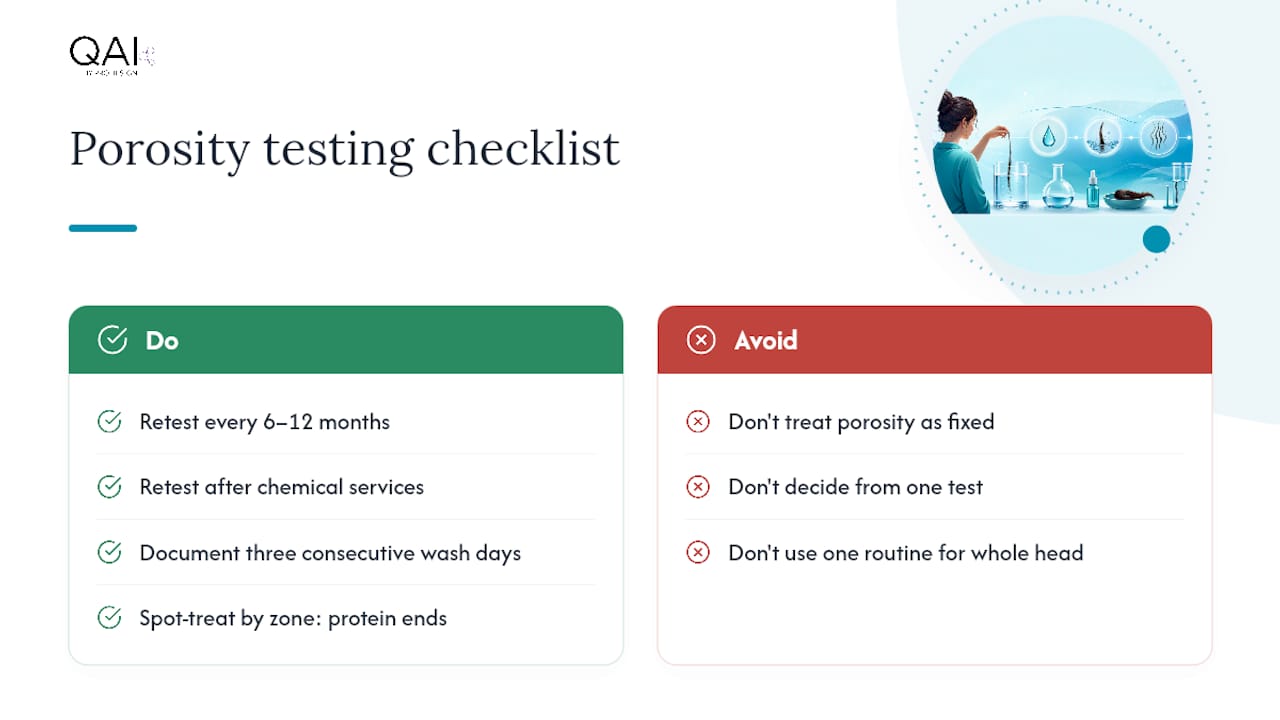
Porosity is dynamic. Bleach, heat, seasonal humidity, and even hard water exposure shift it over months. Retesting every 6–12 months, or after any major chemical service, is a reasonable baseline. If you color regularly or use heat tools often, retest more frequently.
The habit that actually reduces misleading results: document your observations across three consecutive wash days before deciding your porosity label. Note drying time, how products absorb, and whether frizz increases in humidity. Three data points beat one.
For mixed-porosity heads: don’t try to run one routine for your whole head. Apply protein treatments to your ends (typically higher porosity) and lighter humectants to your roots. Spot-treating by zone is more effective than a blanket approach, and it’s what professional stylists do. If you’re working with extensions, porosity affects bonding and moisture retention in the natural hair underneath, so zone-specific care matters even more in that context.
Retest after any bleach, relaxer, or color service. And retest when seasons change, especially if you live somewhere with dramatic humidity swings.
QAI Tiger Reconstructor Masque for porosity repair
If your tests point to high porosity, or you’re dealing with breakage and rapid moisture loss that a standard conditioner isn’t fixing, the QAI Tiger Reconstructor Masque is worth adding to your routine.
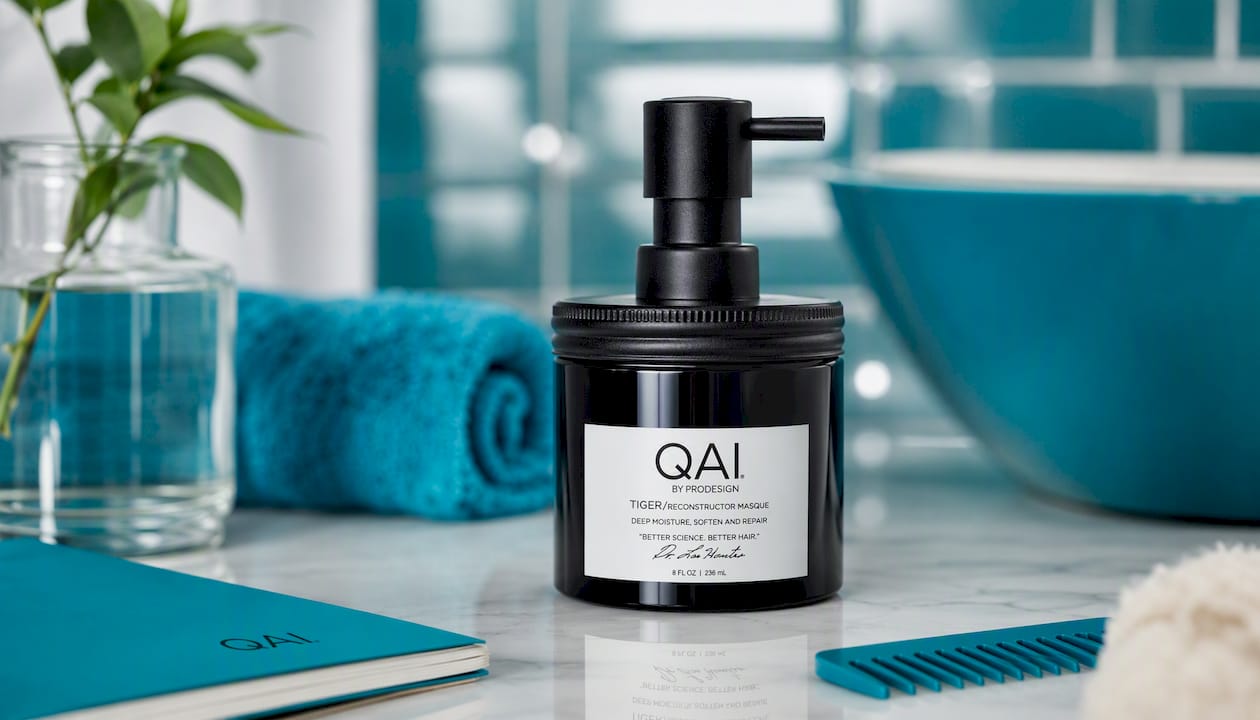
Formulated with the PolyGraft-9 Complex, it targets the cortex and cuticle to rebuild internal structure and level porosity imbalances. It’s particularly effective for hair that’s been bleached, color-treated, or heat-damaged. Use it once or twice a week during a repair phase, then drop to monthly maintenance once your porosity stabilizes. Medium-porosity hair benefits from it as a monthly treatment to maintain cuticle integrity. Low-porosity hair generally doesn’t need it unless breakage is present.
QAI Hair publishes this article and sells this product. The recommendation is based on the formulation’s fit with the repair strategies described above. Browse the full QAI Hair education hub for more on porosity-specific routines and product science.

