


Glyoxylic acid hair treatment smooths frizz and improves manageability for most textures, but it doesn’t deliver the flat, permanent straightening that alkaline relaxers do. Lab studies confirm real fiber damage, including measurable protein loss, and peer-reviewed case reports have linked topical use to rare acute kidney injury from oxalate buildup. Get it from a trained professional, space out applications, and call a doctor if you notice unusual swelling, reduced urination, or flank pain afterward.
TL;DR:
- Glyoxylic acid treatments improve manageability and reduce frizz but do not provide the permanent straightening of alkaline relaxers, relying on repeated heat passes.
- Hair damage from glyoxylic acid is well documented, with protein loss exceeding that seen with some chemical relaxers and rare cases of kidney injury linked to oxalate crystal buildup.
- Effectiveness lasts around two months, especially for porous, frizz-prone hair, but results vary based on hair type, climate, and aftercare routines.
- Clients with kidney issues, scalp lesions, or who are pregnant should consult a healthcare professional before treatment, and proper client screening is essential.
- Post-treatment repair with biomimetic products is crucial to rebuild hair structure after the chemical and heat reshaping process.
How Does Glyoxylic Acid Smooth Hair?
Glyoxylic acid works through aldehyde-like chemistry rather than the disulfide-cleaving reactions that drive alkaline relaxers. Applied to the hair shaft, it reacts with keratin’s amino groups to form imine, or Schiff-base, bonds, then undergoes dehydration reactions that rearrange the protein’s internal structure. That process, detailed in a multidisciplinary lab investigation, only finishes its job under heat.
A flat iron, typically run at high temperatures, drives the biopolymerization that locks the new shape in and forms a thin smoothing film over the cuticle. This is the mechanical opposite of an alkaline relaxer, which breaks disulfide bonds outright to permanently restructure the hair. Glyoxylic acid’s effect depends on repeated flat-iron passes, which is exactly why heat exposure, not the acid alone, drives most of the strand’s structural change.
What Results Should You Expect, and How Long Do They Last?
Most people see smoother texture, less frizz, and easier daily styling, not the pin straight finish associated with alkaline relaxers. Industry educator guidance on smoothing chemistry is consistent on this point: manage expectations before the client sits in the chair, because glyoxylic acid is a manageability treatment first and a straightening treatment second.
Durability typically lasts for a couple of months, though several variables can shift that window:
- Hair porosity and how much product penetrates the cortex
- Humidity and climate exposure after the service
- Shampoo frequency and whether sulfate-heavy cleansers strip the smoothing film
- Heat styling habits in the weeks following treatment
Porous, frizz-prone hair tends to respond best, since the acid has more surface area and internal damage sites to bond with. Fine, already-smooth hair often sees a smaller payoff for the same chemical exposure. If a client wants guaranteed pin-straight results and has virgin, undamaged hair, another method may serve them better than a glyoxylic acid hair treatment.
What Does the Evidence Say About Hair and Health Risks?
The fiber damage is well documented. Comparative testing published in the International Journal of Trichology found measurable protein loss after glyoxylic acid treatment, in some single-application tests exceeding the loss seen with alkaline straighteners. SEM and Raman spectroscopy in the Wiley multidisciplinary study confirmed visible conformational changes in the keratin structure, consistent with the imine-formation mechanism described above.
Key finding: A NEJM clinical correspondence documented acute kidney injury cases tied to hair-straightening products containing glyoxylic acid, with kidney biopsies showing calcium oxalate crystal deposits.
The proposed pathway: glyoxylic acid absorbed through the skin or scalp converts to glyoxylate, which the liver metabolizes into oxalate. Circulating oxalate can then crystallize in the kidneys as calcium oxalate, producing acute nephropathy. A case series with supporting mouse-model experiments found that topical exposure raised urinary oxalate excretion and produced crystalline nephropathy in animal models, which strengthens the case that this isn’t just a coincidental clinical association.
A few points on scale matter here:
- Reported AKI cases remain rare relative to the volume of glyoxylic acid treatments performed worldwide
- Most published cases involve repeated or high-concentration exposure, often in individuals with scalp irritation or open lesions
- Large-scale epidemiological data connecting dose, frequency, and risk is still limited
- Regulatory reviews acknowledge that dermal absorption data for glyoxylic acid remains incomplete
The gap in the research isn’t whether the mechanism is plausible. It clearly is. The gap is in knowing exactly how much exposure, over what timeframe, tips a healthy client into risk territory.
Who Should Avoid Glyoxylic Acid Treatments or See a Doctor First?
Screening matters more here than most stylists treat it. Before booking anyone for a glyoxylic acid hair treatment, run through these checks:
- Kidney history. Anyone with existing kidney disease, a history of kidney stones, or reduced kidney function should talk to a physician before scheduling the service.
- Scalp integrity. Open sores, active dermatitis, recent chemical burns, or fresh scratches increase absorption risk and should postpone treatment.
- Pregnancy. Limited safety data on dermal absorption during pregnancy is reason enough to default to caution.
- Medication and supplement interactions. Flag anyone on high-dose vitamin C or calcium supplements, since both influence oxalate metabolism.
In the salon, keep product off the scalp whenever possible, use gloves and adequate ventilation, and cap flat-iron passes and temperature rather than chasing maximum smoothness on the first visit.
Pro Tip: Keep a written client intake log noting kidney history and prior chemical services. If a client returns within six to eight weeks asking for a repeat treatment, that’s your cue to ask about swelling, urine changes, or fatigue before you touch the bottle again.
Afterward, watch for reduced urination, flank pain, swelling in the legs or face, or unusual fatigue. Any of those warrants immediate medical evaluation.
What Happens During a Glyoxylic Acid Smoothing Service?
A typical service follows a predictable sequence: clarifying shampoo to strip buildup, sectioning, even product application while avoiding scalp contact, a development period, blow-drying to near-total dryness, then multiple flat-iron passes per section to activate the smoothing film. Some protocols include a final rinse or neutralizing step depending on the formula.
Aftercare determines how long the results hold and how much cumulative damage builds up over repeat visits.
- Space reapplications with a safe interval, longer if hair shows signs of stress
- Use sulfate-free cleansers to protect the smoothing film
- Alternate protein-focused and moisture-focused products to avoid protein overload, which stiffens and weakens overtreated strands
- Skip additional chemical services (color, relaxers) for at least two weeks after smoothing
Before booking, ask your stylist what concentration they use, how many flat-iron passes are standard, and whether they screen for kidney history. A stylist who welcomes those questions is usually the one applying the right professional controls.
Glyoxylic Acid vs. Formaldehyde Smoothing vs. Alkaline Relaxers
Formaldehyde-based smoothing produces strong, long-lasting straightening but carries known respiratory and carcinogenicity concerns tied to formaldehyde gas release under heat. Alkaline relaxers break disulfide bonds directly, giving the most permanent straightening of the three, at the cost of higher scalp irritation risk and more severe damage if left on too long.
Glyoxylic acid sits in between: milder scalp irritation than alkaline relaxers, no formaldehyde exposure, but a manageability result rather than full straightening, plus documented protein loss and the oxalate concerns above. A stylist typically reaches for it when a client wants reduced frizz without permanent chemical restructuring and has no active scalp conditions or kidney history that would rule it out.
QAI Hair’s Science-First Take on Post-Treatment Repair
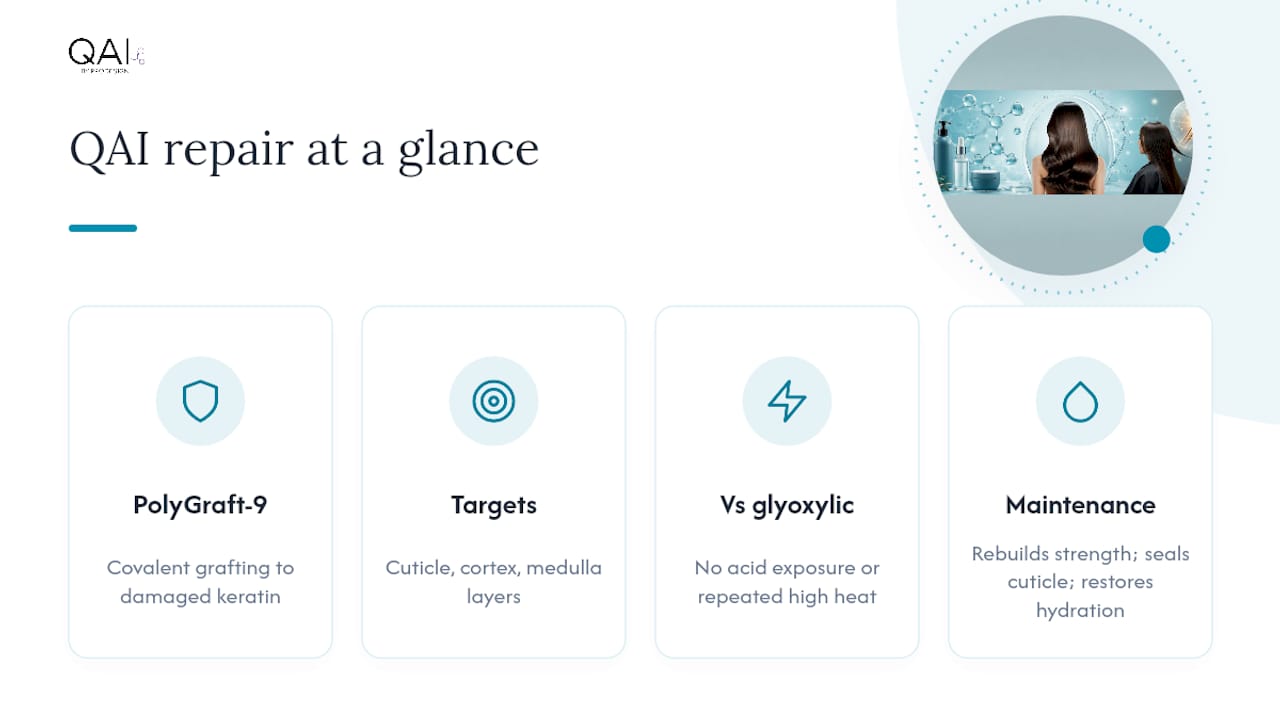
Chemical smoothing changes hair’s internal structure. Repairing that structure requires a different chemistry than the acid-and-heat process that reshaped it. QAI Hair’s Covalent Grafting Polypeptide technology, built around the PolyGraft-9 Complex, was developed by Dr. Lee Hunter to bond directly with damaged keratin sites rather than coat the strand temporarily.
Where glyoxylic acid smoothing rearranges keratin through imine formation and heat, PolyGraft-9’s covalent grafting approach targets three hair layers (cuticle, cortex, and medulla) to rebuild structural integrity biomimetically, without relying on acid exposure or repeated high-heat styling.
For maintenance after a smoothing service, QAI Tiger Reconstructing Shampoo rebuilds strength in treated strands, QAI Liquid Hair reinforces and seals the cuticle, and QAI Moisture Shampoo restores hydration balance that acid treatments and repeated flat-ironing tend to strip away.
The Trade-Off Nobody Wants to Say Out Loud
Glyoxylic acid smoothing works. It genuinely reduces frizz and makes hair easier to manage, and the lab data backs that up. But the same studies showing measurable protein loss and keratin rearrangement are the ones that should make stylists conservative about frequency, not just technique.
The oxalate nephropathy cases are rare, but rare doesn’t mean irrelevant when the exposure is voluntary and cosmetic. What’s missing from the research right now is basic: how much dermal absorption actually happens under real salon conditions, and over what timeframe repeated exposure becomes a genuine kidney risk. Until that data exists, conservative spacing and professional oversight aren’t optional extras. They’re the whole safety strategy.
— Kollin Gessler
Rebuild What Smoothing Strips Away
Glyoxylic acid treatments trade some structural integrity for smoother, more manageable hair, and that trade only pays off long term if you rebuild what the process strips away. QAI Hair’s repair system exists for exactly that gap between the acid-and-heat chemistry that reshapes hair and the biomimetic chemistry that restores it afterward.
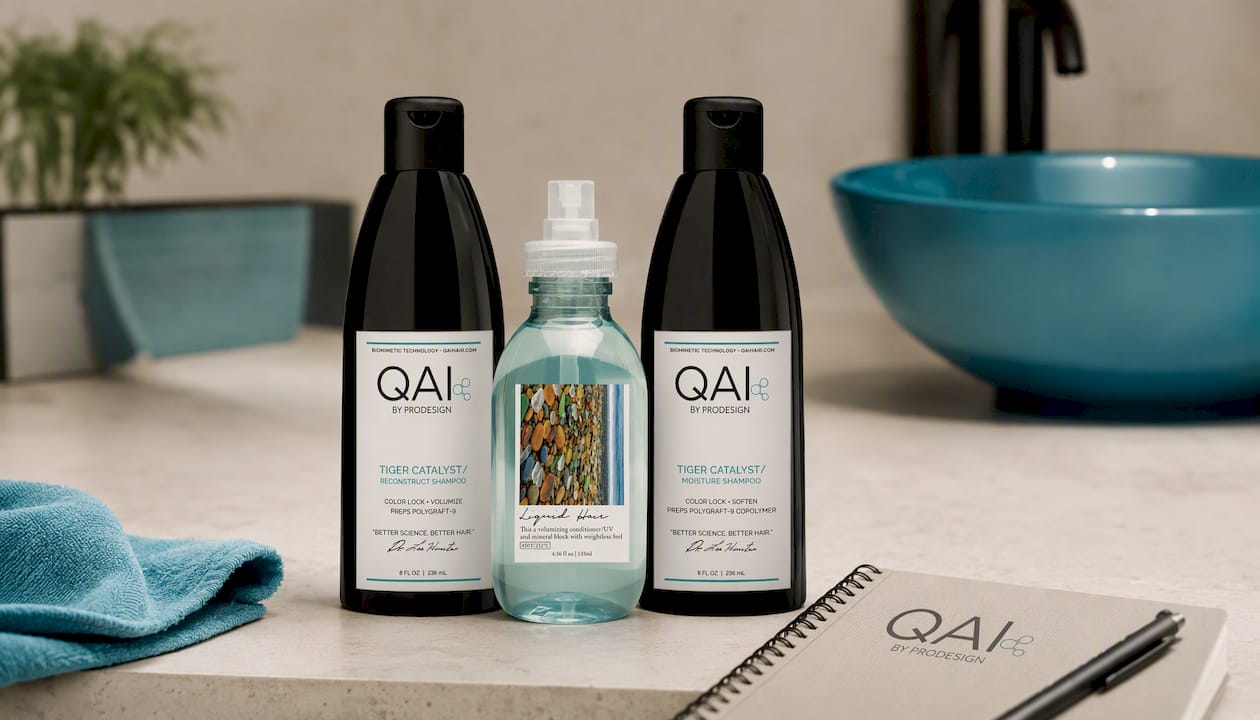
Start with QAI Tiger Reconstructing Shampoo to rebuild protein structure lost during smoothing, layer in QAI Liquid Hair to seal and reinforce the cuticle, and finish with QAI Moisture Shampoo to restore hydration balance that repeated flat-ironing pulls out. Salons managing client screening and service scheduling around treatments like this often lean on tools such as Bossy’s salon management platform to track chemical service history alongside appointments. Consider adding reconstructing shampoos and treatments after smoothing services to give treated strands the repair step the process itself doesn’t include.
This article is general information, not a substitute for advice from a qualified doctor. Consult a qualified healthcare professional about your own circumstances before acting on anything here.
Sources
- Kidney Injury and Hair-Straightening Products Containing …
- Hair-straightening cosmetics containing glyoxylic acid induce crystalline nephropathy
- Formaldehyde replacement with glyoxylic acid in semipermanent hair straightening: a new and multidisciplinary investigation
- Impact of Acid (”Progressive Brush”) and Alkaline… : International Journal of Trichology
FAQ
Is Glyoxylic Acid Safe for Hair?
It’s reasonably safe for most healthy people when applied by a trained professional with proper scalp protection, but lab studies confirm real protein loss and rare case reports link topical use to acute kidney injury, so screening and spacing matter.
Where Can I Buy Glyoxylic Acid Hair Treatment Products?
Professional-strength glyoxylic acid smoothing systems are typically sold to licensed salons through beauty supply distributors rather than retail shelves; for post-treatment repair, QAI Tiger Reconstructing Shampoo and QAI Liquid Hair are available directly through QAI Hair.
What Is Another Name for Glyoxylic Acid?
Glyoxylic acid is also called oxoacetic acid, and in hair care marketing it sometimes appears under the umbrella term “acid smoothing” or “progressive brush” treatments.
What Are the Side Effects of Glyoxylic Acid on Hair?
Documented side effects include measurable protein loss and structural keratin changes visible under SEM and Raman analysis, along with rare but serious systemic reports of calcium oxalate nephropathy from topical exposure.
Is Glycolic Acid the Same as Glyoxylic Acid for Hair?
No. Glycolic acid is an alpha hydroxy acid used mainly for exfoliation and scalp care, while glyoxylic acid is the aldehyde-acid compound responsible for the keratin rearrangement in smoothing treatments.

