


The best Redken alternatives fall into four categories: drugstore bond-builders for light maintenance, salon-professional lines for closer formula matches, plex-style treatments for structural repair, and cruelty-free brands for ethical buyers. For genuine repair and color locking, QAI Hair’s Covalent Grafting Polypeptide system stands out as the salon-grade option worth the switch. Expect trade-offs between cost, texture compatibility, and how quickly you see results.
TL;DR:
- Bond-building and plex-style alternatives provide the most visible repair benefits, especially for chemically treated or heat-styled hair, but they come with a higher cost per ounce.
- Salon-professional options like L’Oréal EverPure and Matrix tend to closely match Redken’s formulas and offer more stable long-term pricing than luxury retail brands.
- Switching to a science-backed repair system like QAI Hair’s covalent grafting technology delivers targeted structural repair and is especially effective for severe damage but requires a proper routine over several weeks to see results.
- Evaluating alternatives requires checking pH levels, active ingredients, sulfate-free status, and cost per ounce, with attention to individual hair type and damage level for best results.
- Transitioning to cruelty-free and vegan formulas demands careful review of third-party certifications and ingredient lists to prevent allergic reactions or reduced performance.
What Are the Best Redken Alternative Categories?
Not every “dupe” earns the name. A shampoo that smells the same and lathers the same can still leave your hair drier and duller after six weeks, because the categories that claim to replace Redken perform very differently, depending on what your hair actually needs.
Drugstore value options rely on cheaper surfactants, silicone blends, and hydrolyzed proteins to fake softness fast. They work well for fine or slightly damaged hair that just needs a smoothness boost between salon visits. The catch: drugstore bond-building and moisturizing lines tend to deliver good short-term softness and value, but they usually need pairing with a stronger weekly treatment to produce lasting repair. If your hair is bleached, over-processed, or breaking at the ends, a $9 bottle alone will not fix it.
Salon-professional alternatives sit in the middle price tier and usually come closest to matching Redken’s actual chemistry. Comparison testing that looks at ingredient overlap has flagged lines like L’Oréal EverPure and Matrix’s salon-professional range as frequently recommended lower-cost matches for Redken All Soft-style results, since salon-leaning brands tend to formulate closer to professional standards than mass-market drugstore lines do. These brands also tend to hold steadier prices over time. Industry pricing analysis notes that salon-focused retailers show less price volatility than luxury retail brands, which makes them a more predictable long-term swap if you are budgeting month to month.
Bond-building and plex-style alternatives are where the real repair claims live, and where marketing language gets slippery. True bond-building formulas contain molecules designed to reconnect broken disulfide bonds inside the hair shaft, not just coat the surface. This is a fundamentally different job than a moisturizing conditioner does, and it is why plex-style treatments cost more per ounce. If you color-treat your hair, bleach it, or use heat tools daily, this category is where you will see the biggest visible difference in breakage and shine.
Cruelty-free and vegan choices matter to a growing share of shoppers, but “cruelty-free” and “effective” are not the same checkbox. Look for Leaping Bunny or PETA certification rather than a brand’s own claim on the label, since self-reported cruelty-free branding has no third-party audit behind it. Some cruelty-free lines skip animal-derived keratin and instead lean on plant proteins or amino acid blends, which can perform differently on coarse or very porous hair. Test a small section first if you are switching from an animal-protein-based Redken formula to a plant-based one.
Here’s how the categories generally sort by hair type:
- Fine or slightly damaged hair: drugstore value shampoos plus a lightweight conditioner, no heavy masque needed.
- Color-treated hair: salon-professional lines or acidic-sealing formulas that protect pigment molecules during rinse-out.
- Thick, coarse, or chemically processed hair: bond-building treatments layered with a reconstructing masque at least once weekly.
- Sensitive scalp or ethical priorities: certified cruelty-free lines, tested in a small patch first.
How Do You Evaluate a Redken Alternative Before Buying?
Check the pH first, then the actives, then the price per ounce. In that order. Most shoppers do it backward, chasing price and ignoring formulation, which is exactly how they end up disappointed six weeks in.
Here’s a practical checklist for reading a label like a formulator would:
- Check the pH. Healthy hair and scalp sit around pH 4.5 to 5.5, slightly acidic. Specialist formulation analysis of Redken-style alternatives confirms that acidic formulas in that range help reseal the cuticle and lock in color after a wash, while alkaline formulas (anything closer to pH 7 or above) tend to swell the hair shaft and strip color faster. Most brands do not print pH on the bottle, so check the brand’s website or ingredient forums before buying.
- Look for named active ingredients, not vague claims. “Repairing” and “strengthening” mean nothing on their own. Look instead for hydrolyzed keratin, hydrolyzed wheat or silk protein, panthenol, or a named bond-building complex. If the label just says “bio-technology” with no ingredient backing it up, be skeptical.
- Confirm sulfate-free labeling for color-treated hair. Sodium lauryl sulfate strips color molecules fast. If you color your hair, sulfate-free is non-negotiable, not a nice bonus.
- Do the cost-per-ounce math, not just the shelf price. A $12 bottle that is 8 ounces of concentrated formula can beat a $22 bottle that is 16 ounces of diluted filler. Guides comparing Redken dupes consistently point out that assessing cost-per-ounce and concentration matters more than sticker price, because plenty of “budget” bottles are just smaller or watered down.
- Verify cruelty-free claims through Leaping Bunny or PETA, not brand copy. A bunny logo on the front does not always mean a real audit happened behind it.
- Decide where you actually need salon-grade strength. If your hair is bleached, relaxed, or heat-styled daily, a concentrated professional repair system earns its price. If your hair is healthy with only mild frizz, a well-formulated drugstore line will likely do the job.
Pro Tip: Snap a photo of your current Redken product’s ingredient list before you shop. Comparing it side by side with a potential alternative on your phone takes thirty seconds and saves you from a $20 mistake.
One more filter worth applying: check if the product line is sold through professional or salon-adjacent channels rather than only mass retail. Analysis of pricing models for professional-tier alternatives found that salon and B2B distribution channels tend to be more cost-stable and often offer bulk sizing, which improves long-term value for anyone replacing a Redken routine permanently rather than just trying a bottle once.
How Long Does It Take to See Results After Switching?
Give it four to eight weeks before judging a new routine, not one wash. Hair care marketing loves the phrase “instant results,” but real structural repair happens gradually, wash by wash, as damaged sections get replaced by new growth or as bond-building actives accumulate inside the shaft.
- Week one: judge texture, not shine. Your first wash with a new alternative should feel different in the shower, less tangling, easier detangling with a wide-tooth comb. Do not expect visible shine or bounce yet. If your hair feels stripped, waxy, or unusually tangled after the first wash, the formula’s pH or surfactant blend probably does not suit your hair type, and it is worth switching before you commit a whole bottle.
- Weeks one through four: build the weekly rhythm. Shampoo and conditioner on your normal wash days, then add a reconstructing masque or treatment once a week. Follow with a lightweight leave-in or styling cream to lock in smoothness without weighing hair down. This is where bond-building actives get the repeated exposure they need to actually rebuild strength rather than just coat the surface temporarily.
- Weeks four through eight: watch for compounding improvement. Breakage at the ends should slow down. Color-treated hair should hold its tone through more washes before fading. Frizz should respond faster to heat styling. Guides on plex-style repair note that serious repair usually requires a matching maintenance routine, meaning a once-weekly masque paired with a bond-focused shampoo, rather than swapping only the shampoo and conditioner and expecting salon-level results.
- Red flags at any point: persistent dryness that does not improve after two weeks, unusual shedding, scalp irritation, or hair that feels “gummy” when wet. Any of those signals mean stop and switch, or book time with a stylist who can look at your actual strand health under good lighting.
Why QAI Hair’s Covalent Grafting Technology Stands Apart
Most alternatives coat the hair shaft. QAI Hair’s approach is built to bond to it. The brand’s Covalent Grafting Polypeptide technology uses a proprietary PolyGraft-9 Complex, described as the first reactive covalent grafting polypeptide, engineered to attach to damaged sites within the hair’s structure rather than sitting on the surface like a typical conditioning agent. The formula is paired with Sea Sand Silicone, Bio Hydroxy Acids, and Fruit Lipids to work across all three layers of the strand, from the outer cuticle down through the cortex.
Dr. Lee Hunter, who founded QAI Hair after leadership roles at brands including Clairol and Redken, built the system around 37 years of personal care research. That background matters here specifically because the formulation problem QAI set out to solve, permanently repairing structural damage without relying on heavy oils or silicones that just mask breakage temporarily, is the same problem cost-conscious shoppers run into when a drugstore dupe fades in performance after a few washes.
The QAI catalog maps directly onto common Redken use cases:
- QAI Tiger Reconstructing Shampoo replaces a Redken repair shampoo, cleansing while priming strands for the covalent grafting process.
- QAI Tiger Reconstructor Masque functions as the weekly deep-repair treatment, similar in role to a Redken bond-building masque but built on the PolyGraft-9 base.
- QAI Liquid Hair works as a leave-in support product for smoothing and color retention between washes.
- QAI Tiger Reconstruct serves as the professional-tier treatment for readers considering a more intensive, salon-style repair kit.
- QAI Texture Ultra Light Styling Cream finishes the routine with frizz control that does not weigh hair down.
QAI’s products are used by professional stylists, which matters if you are trying to judge whether a smaller brand’s repair claims hold up outside a marketing page. If your hair is severely bleached, chemically relaxed, or breaking at multiple points along the shaft, this is where a science-backed system pulls ahead of a drugstore bottle. If your damage is mild, a well-chosen drugstore or salon-professional alternative from the categories above may be enough.
Could an Alternative Trigger a Reaction Your Redken Products Never Did?
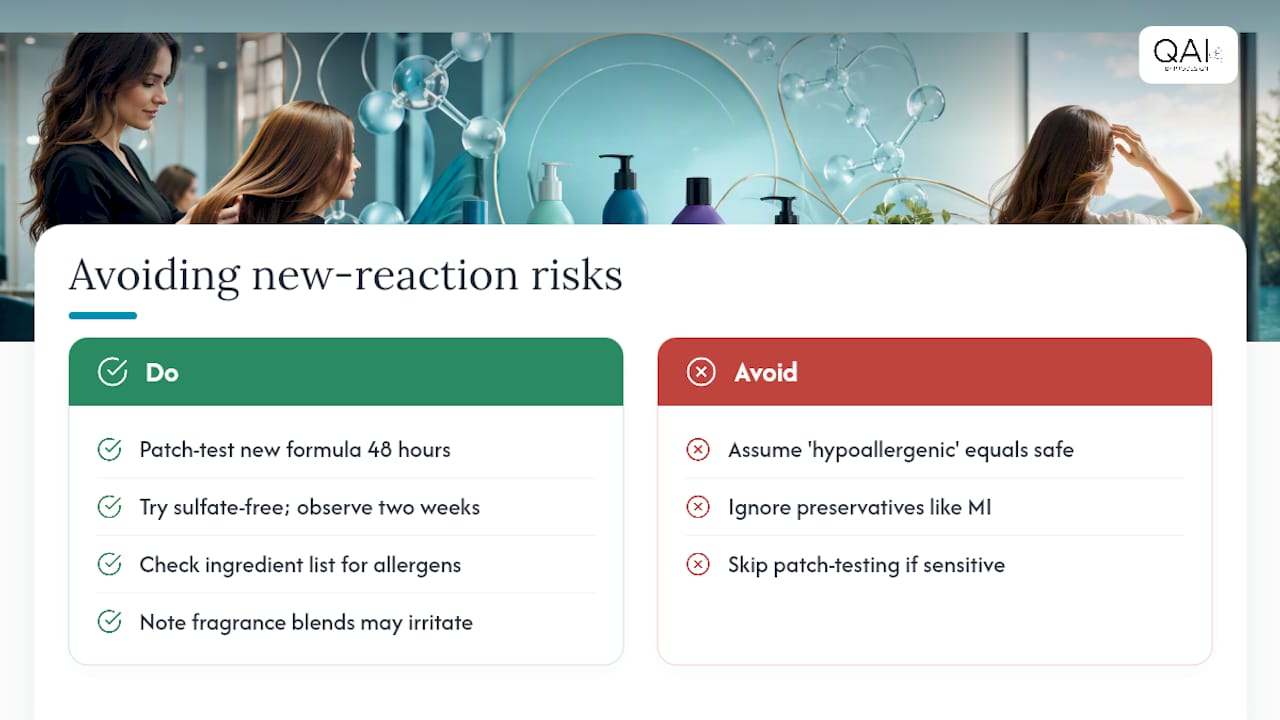
Switching formulas means switching allergen exposure, even if the marketing sounds identical. Fragrance is the most common irritant across the entire haircare category, and reformulated “dupe” products frequently use different fragrance blends than the Redken product they are mimicking, even when the bottle smells similar on the shelf.
Sulfates, while good for stripping color fast, can also aggravate sensitive or eczema-prone scalps more than a gentler surfactant blend would. If you switch to a sulfate-free alternative and your scalp calms down within two weeks, that is a strong sign sulfates were the original irritant, not the brand itself.
Preservatives like methylisothiazolinone and certain parabens show up more often in budget drugstore formulas than in salon-professional or plex-style lines, and they are known contact allergens for a subset of users. Plant-based proteins in cruelty-free formulas, like soy, wheat, or oat protein, can also cross-react with existing food allergies in rare cases. If you have a diagnosed wheat or soy allergy, check the ingredient list closely before trying a vegan alternative marketed as hypoallergenic by default. Patch-test any new formula on a small section behind your ear or at the nape of your neck for 48 hours before a full application, especially if you have a history of scalp sensitivity.
How Do Alternative Brands Compare on Reputation and Support?
Reputation in this category tracks two things: return policy flexibility and how fast a brand responds when a formula does not work for someone’s specific hair type. Salon-professional brands sold through licensed stylists tend to have stronger reputations for consistency, since the product reaches consumers after a professional has already vetted it for real-world performance across many clients.
Drugstore brands compete mostly on price and availability, and their customer service infrastructure reflects that. Returns are usually handled through the retailer, not the brand directly, which means a bad batch or a bad reaction is harder to resolve quickly. Brands built around a named scientist or formulator, rather than an anonymous corporate line, tend to publish more detailed ingredient and mechanism information, which builds trust with shoppers who actually read labels before buying. That transparency also tends to correlate with more responsive support, since a brand willing to explain its formulation chemistry publicly is generally more willing to stand behind it when something goes wrong.
What Do Redken’s Core Product Lines Actually Do?
Knowing what you are replacing helps you replace it correctly. Redken’s All Soft line targets dry, coarse hair with argan oil and a moisture-focused formula built for softness rather than structural repair. Its Extreme line is the bond-repair workhorse, aimed at chemically or heat-damaged hair using protein-based actives to rebuild strength. Color Extend Magnetics is built specifically for color-treated hair, using ionic technology to help pigment molecules stay bonded to the hair shaft through repeated washing.
Each line solves a different problem, which is exactly why a single “Redken alternative” rarely exists. A dry-hair shopper replacing All Soft needs a moisture-forward formula. A shopper replacing Extreme needs genuine bond-building actives, not just a rich conditioner. Matching your alternative to the specific Redken line you used, rather than the brand as a whole, is the single biggest factor in whether the switch actually works.
Is a Science-Backed Repair System Worth the Extra Cost?
The honest answer depends on how damaged your hair actually is, not how damaged you think it is. A lot of cost-conscious shoppers default to the cheapest dupe on the shelf and then wonder why their ends keep splitting six months later. If your hair has been bleached, relaxed, or heat-styled for years, the structural damage is happening at a molecular level that a $9 conditioner was never designed to fix.
That is where paying up for a system built around actual repair chemistry, rather than surface conditioning, makes financial sense over a full year rather than a single bottle. Budgeting for haircare works the same way budgeting for any recurring service does. Just as service costs scale with the actual work involved rather than a flat rate, a repair-focused routine costs more upfront but usually reduces how often you need salon corrective work down the line.
My practical advice: spend where the damage is real, save where it is not. A once-weekly masque built on real bond-building science, paired with a budget shampoo for daily washing, often beats an all-premium routine you cannot sustain financially.
— Kollin Gessler
QAI Products for Anyone Ready to Switch
QAI Hair is the alternative to guesswork bottle-swapping. Instead of hoping a drugstore dupe happens to match your specific damage type, you get a formulated system built around one repair mechanism, covalent grafting, applied consistently across shampoo, treatment, and styling steps.

Start with the QAI Tiger Reconstructing Shampoo, the daily cleansing step that primes strands for repair. Follow it weekly with the QAI Tiger Reconstructor Masque, the deep-repair treatment built for hair dealing with real breakage or chemical damage. Between washes, QAI Liquid Hair works as a leave-in support step for smoothing and color retention, and the QAI Texture Ultra Light Styling Cream finishes the look without weighing hair down. For a more intensive kit-level approach, QAI Tiger Reconstruct is built for those wanting a salon-style repair regimen at home.
If you want the technical explanation behind why this approach works differently than a standard conditioner, the covalent polypeptide science page breaks down the mechanism in more depth. Browse the full lineup at the QAI Hair store and pick the step that matches where your hair actually needs help first.
Sources
QAI Hair’s own science page on covalent grafting polypeptide technology explains the mechanism behind PolyGraft-9 Complex in full detail. For formulation criteria like pH balance and active ingredient selection, the independent analysis on Redken alternatives offers a useful framework for evaluating any competing product. For category-by-category comparisons of specific dupes, the Redken All Soft dupe roundup breaks down which brands come closest on formulation and price.
- In-Depth Analysis: Finding Quality Alternatives to Redken Professional Hair Care - En Suite (Oct 2025)
- Top Redken All Soft Dupe Hair Products 2026 · FindingFavourites
FAQ
Is L’Oréal a Dupe for Redken?
L’Oréal’s professional lines, including EverPure, are frequently cited in ingredient-match comparisons as close formula parallels to Redken All Soft, particularly for moisture and softness goals, though results vary by specific product pairing.
Which Is Better, Olaplex or Redken?
Both target bond repair but through different mechanisms. Olaplex focuses narrowly on disulfide bond repair, while Redken’s Extreme line combines protein actives with moisture agents, so the better choice depends on whether your hair needs pure bond repair or broader conditioning alongside it.
What Is a Good Dupe for Redken All Soft Conditioner?
Salon-professional moisturizing conditioners with argan oil or similar emollients tend to match All Soft’s softness goals most closely, while a bond-building system like QAI’s Tiger Reconstructing line targets deeper repair rather than surface softness alone.
What’s a Dupe for Redken All Soft Shampoo?
Look for a sulfate-free, moisture-focused shampoo with hydrolyzed proteins and a similar oil profile; salon-leaning brands generally outperform basic drugstore shampoos on this specific match, according to comparison testing of ingredient overlap.
How Much Does It Cost to Switch From Redken to an Alternative?
Costs vary widely by category, from budget drugstore bottles to salon-professional lines with a higher price point; QAI Hair’s product pricing is listed directly on each product page rather than through a fixed conversion chart.

