


- Provenance: the formula traces to the late Dr. Lee Hunter, former Senior Vice President of Chemistry at Redken, and was brought to market by his grandson, Kollin Gessler.
- The name: PolyGraft-9 is the specific reactive cysteine protein at the center of the claim, not a marketing umbrella term.
- Early signal: partner salons testing the technology on severely compromised hair reported outstanding results ahead of the public launch.
Key Takeaways
PolyGraft-9 permanently grafts a synthetic polypeptide into the hair cortex, restoring covalent bonds that heat, bleach, and color break down over time.
| Point | Details |
|---|---|
| What it is | PolyGraft-9 is QAI Hair’s reactive covalent grafting polypeptide, paired with the Tiger Catalyst for controlled bonding. |
| Best use cases | Gummy overprocessed hair, burned strands, uneven porosity, and color-lock services after bleach. |
| Salon protocol | A staged 45 to 60 minute reconstruct service with strand testing before catalyst activation. |
| Home maintenance | Tiger Reconstructing Shampoo and Tiger Reconstructor Masque preserve grafted results between visits. |
| Where to start | QAI Hair sells professional kits and retail SKUs directly, with authorized salon partners for in-chair service. |
What Is the First Covalent Grafting Polypeptide, Chemically?
PolyGraft-9 works by chemically growing a synthetic polypeptide and grafting it directly into the hair’s alpha-helix, the same structural region that keratin bonds normally occupy before heat, bleach, and color strip them away. QAI describes this as mimicking protein synthesis rather than depositing a temporary coating, which is why the company calls it a covalent grafting polypeptide instead of a conditioning protein. Most reparative proteins sit on the cuticle and rinse away in a few washes. This one bonds into the cortex itself.
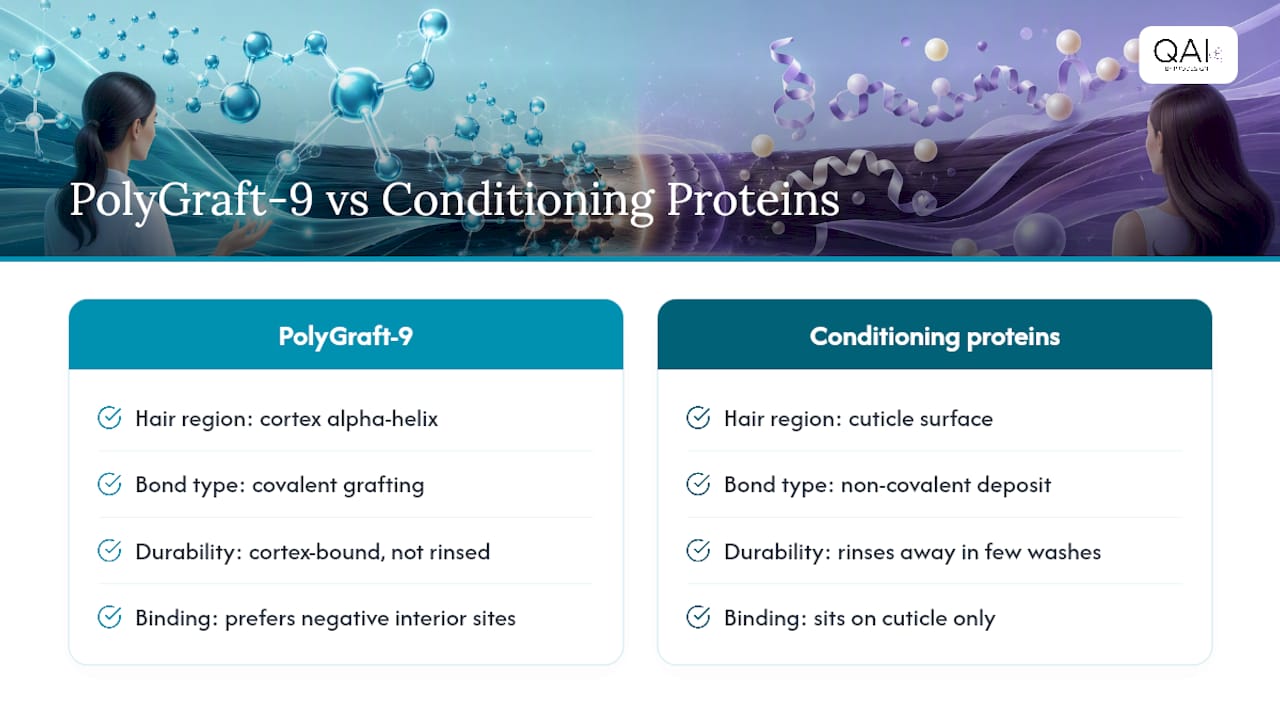
The mechanism depends on a second ingredient: the Tiger Catalyst, also called the Covalent Bond Conversion Catalyst. Damaged, overoxidized hair is actually easier to graft, not harder, because oxidation exposes more reactive sites along the protein chain. QAI’s own formulation notes explain that PolyGraft-9 and the Tiger Catalyst become more reactive as oxidation increases, which flips the usual salon assumption that heavily processed hair is a lost cause.
There is a built-in safeguard. PolyGraft-9 is engineered to bond preferentially with negatively charged sites inside the hair shaft, which keeps the treatment from over-proteinizing strands that are already carrying product buildup. In practice, that means stylists are not stacking protein on top of protein and risking the stiff, glassy overload that ruins a blowout.
Early adopting salon partners have reported that the PolyGraft-9 technology works with outstanding results on hair previously considered too compromised to fix.
That claim, drawn from QAI’s launch announcement, is the closest thing the industry has to field data on this class of ingredient right now.
Which Hair Problems Does PolyGraft-9 Actually Fix?
The technology targets a specific band of damage that most repair lines only manage cosmetically:
- Gummy, elastic, overprocessed hair that stretches and does not spring back.
- Burned or overoxidized strands from repeated bleaching or lightening services.
- Uneven porosity, where some sections absorb color and moisture faster than others.
- Color fade after bleach or high-lift color, where the cortex is too open to hold pigment.
- Keratin loss from heat styling, chemical relaxing, or aggressive brushing.
Clients who benefit most are the ones stylists already dread booking: heavy bleach-and-tone regulars, frequent balayage clients, and anyone arriving for a corrective color service after a box-dye mishap. Veteran stylist Marina Kenard has described using PolyGraft-9 to salvage hair so “gummy” and pulled-apart from over-processing that traditional protocols would have called for cutting it off entirely.
Hair that used to mean an automatic short cut is now a candidate for a reconstruct service instead of a goodbye to length.
How Do Stylists Apply PolyGraft-9 in the Salon?
Stylists integrate PolyGraft-9 through a staged, buffered protocol that pairs the polypeptide with the Tiger Catalyst under controlled oxidation. This is not a single-step masque application. It is a professional service with checkpoints built in.
A standard reconstruct and color-lock protocol runs roughly like this:
- Consultation and porosity/elasticity assessment.
- Strand test with the catalyst to gauge reactivity on that client’s damage level.
- Pre-treatment cleanse to remove buildup that could block grafting sites.
- PolyGraft-9 application, worked through mid-lengths and ends.
- Catalyst activation step under controlled, timed oxidation.
- Neutralize and rinse.
- Finishing service, including color lock if requested.
Plan for roughly 45 to 60 minutes for a standard reconstruct, with another 15 to 20 minutes if a color-lock step is added. Avoid the service on compromised or broken scalp skin, and always run a strand test before working on hair with an unknown chemical history. Check the salon protocol guidance for consultation checklists before a client’s first visit.
Pro Tip: On “gummy” or heavily overprocessed hair, slow the oxidation step down rather than speeding it up. Lower, more patient catalyst exposure grafts more evenly than a fast, aggressive pass and reduces the risk of an uneven, patchy result.
Can Clients Maintain Results With At-Home Products?
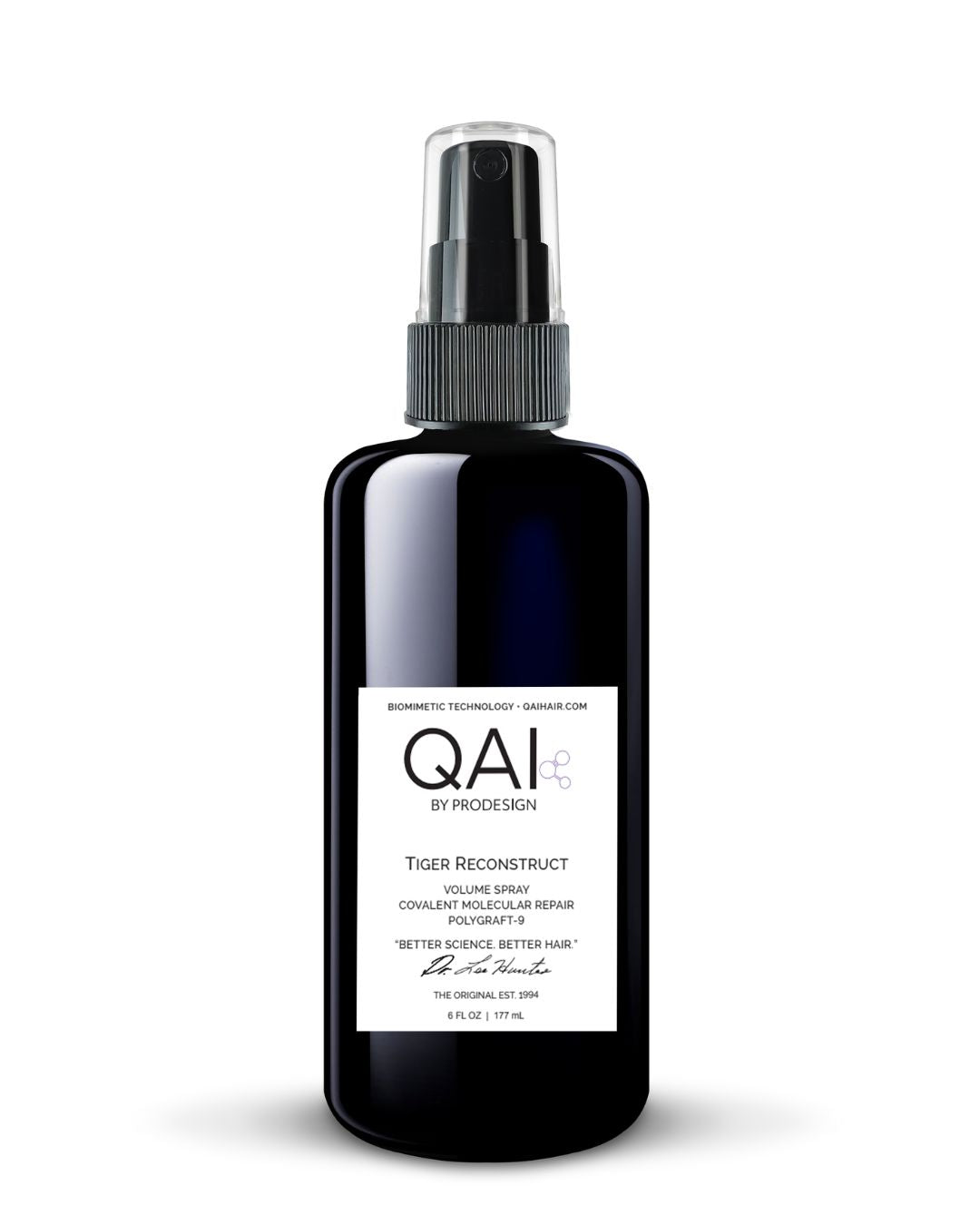
Home products extend a salon result. They do not replace the in-salon grafting procedure itself, because the strongest covalent bonding happens under professional application with the Tiger Catalyst. Three retail SKUs carry the PolyGraft-9 Complex for maintenance between visits:
- QAI Tiger Reconstruct: the flagship reconstructing treatment, built for clients maintaining a recent in-salon service.
- QAI Tiger Reconstructing Shampoo: a cleansing step formulated to avoid stripping grafted polypeptide bonds.
- QAI Tiger Reconstructor Masque: a deep-conditioning follow-up for weekly or biweekly strength maintenance.
Advise clients to use the reconstructing shampoo two to three times a week, follow with the masque once weekly on chemically treated hair, and skip layering multiple heavy proteins in the same wash. Set the expectation early: home care preserves the graft, it does not create one.
Is PolyGraft-9 Safe With Bleach, Color, and Smoothing Services?
PolyGraft-9 treatments are built for professional application and can generally be integrated with common chemical services when protocols and strand tests are followed. That said, a few cautions apply every time:
- Skip the service on compromised, broken, or actively irritated scalp skin.
- Flag any severe allergy history before introducing the catalyst step.
- Never stack uncontrolled oxidative layering (multiple bleach passes plus catalyst) without a strand test first.
For bleach and lightening work, most stylists sequence PolyGraft-9 after the lightening service, once the cortex is most reactive. With perming or formaldehyde-free smoothing, the same professional-only positioning applies. Buffer timing and consult a strand test rather than guessing at compatibility.
Controlled oxidation is what makes grafting on damaged hair possible in the first place. It is treated as a lever the stylist manages, not a hazard to avoid.
What Results Should Clients Expect, and How Long Do They Last?
Structural improvement is visible starting with the first treatment, and color lock and reduced breakage build over the following weeks as the graft integrates with new growth patterns.
- 24 to 72 hours: initial strength set, hair feels noticeably less elastic and gummy.
- 2 to 4 weeks: measurable gains in tensile strength and reduced breakage during styling.
- 8 to 12 weeks: fuller integration, timing depends on hair growth rate and starting damage level.
Maintenance checklist for salon owners to hand clients:
- Book a follow-up reconstruct every 6 to 8 weeks for heavily processed hair.
- Use the reconstructing shampoo and masque on the home schedule between visits.
- Avoid stacking unrelated protein treatments from other lines in the same week.
Why PolyGraft-9 changes the math for salon owners
This is the first ingredient I have seen that turns a “we have to cut it off” consultation into a bookable reconstruct service. That shift matters for salon revenue as much as it matters for the client sitting in the chair. Fewer forced short cuts, more corrective-service upsells, and clients who come back every six weeks instead of disappearing after a bad bleach job.
Where to Buy PolyGraft-9 Products and Book Professional Services
QAI Hair sells the full PolyGraft-9 product line and professional kits directly through its own site, and select salon partners carry the line for in-chair services. If you are a stylist deciding whether to add a reconstruct menu item, the fastest path is stocking the professional kit and running it on a few strand-test clients before a full launch.
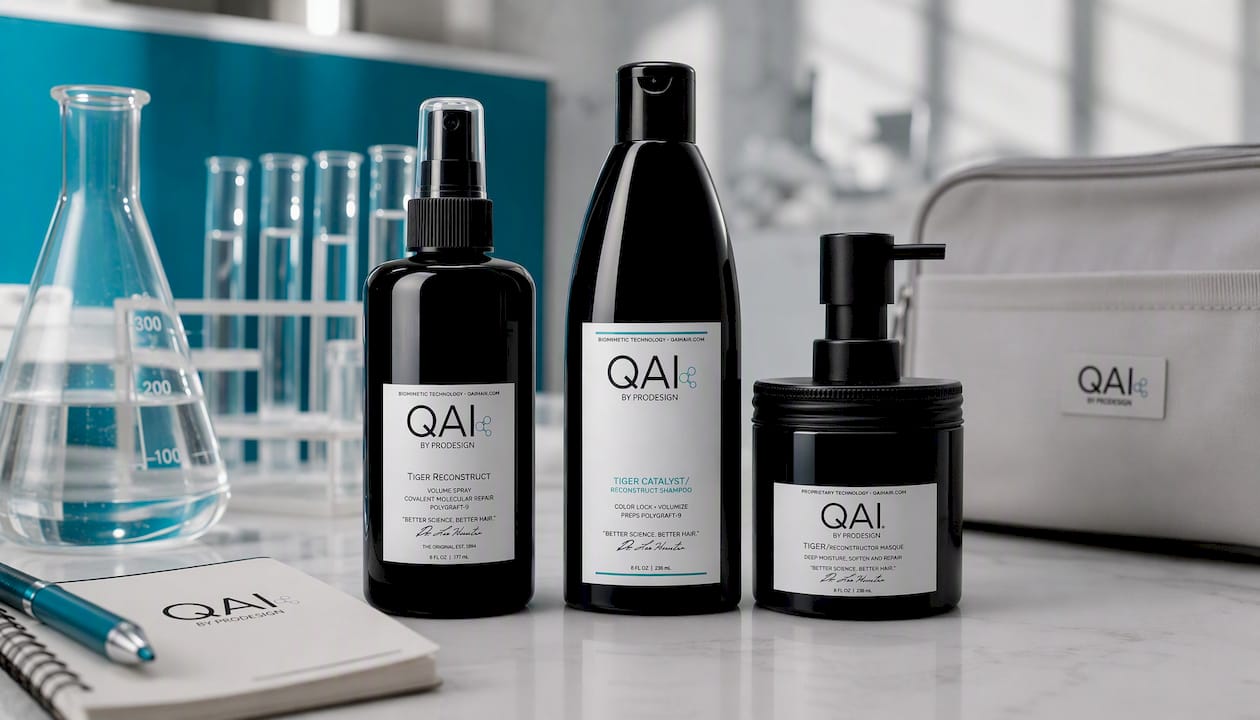
Consumers looking to maintain results at home can order the reconstructing shampoo and reconstructor masque directly, no salon visit required for restocking. Salon owners interested in carrying the professional Tiger Reconstruct kit can reach out through QAI Hair’s site to set up an account. One authenticity note worth repeating to clients: buy PolyGraft-9 products only from QAI Hair directly or from a salon you know carries the authorized line. This is a proprietary formula, and there is no generic equivalent on the market.

